With 80% validator support needed for two weeks, XRPL's May 27 upgrade shows that a fork requires 5 layers beyond unupgraded nodes, says David Schwartz.
"Consensus legitimacy on XRPL flows through trust lists and validator coordination, not through the number of unupgraded nodes."
On May 27, the XRPL network will activate amendment fixCleanup3_1__3, a scheduled maintenance upgrade bundling fixes for NFTs, Permissioned ...
XRPL's amendment process requires more than 80% support from trusted validators sustained for two weeks before new rules become permanent. T...
On May 27, the XRPL network will activate amendment fixCleanup3_1__3, a scheduled maintenance upgrade bundling fixes for NFTs, Permissioned Domains, Vaults, and the Lending Protocol. Version 3.1.3 of rippled already has a default 'Yes' vote due to the importance of these changes. But what makes this episode worth examining is what XRPL co-creator David Schwartz said about what a real fork would actually require — his answer reveals how protocol legitimacy works on any blockchain.
The Signal
XRPL's amendment process requires more than 80% support from trusted validators sustained for two weeks before new rules become permanent. This threshold ensures that the entities the network trusts have reached a durable agreement. Any server that fails to upgrade to version 3.1.3 before May 27 will become amendment-blocked, losing the ability to validate transactions, participate in consensus, or vote on future amendments.
Schwartz explained that raw node count is a poor proxy for consensus power. A system where nodes vote in proportion to their number creates an attack surface: anyone can spin up thousands of machines at low cost. In the XRPL model, each server operator maintains a curated Unique Node List (UNL) — a set of validators the server trusts not to collude. The UNL determines which validation votes the server counts during consensus.
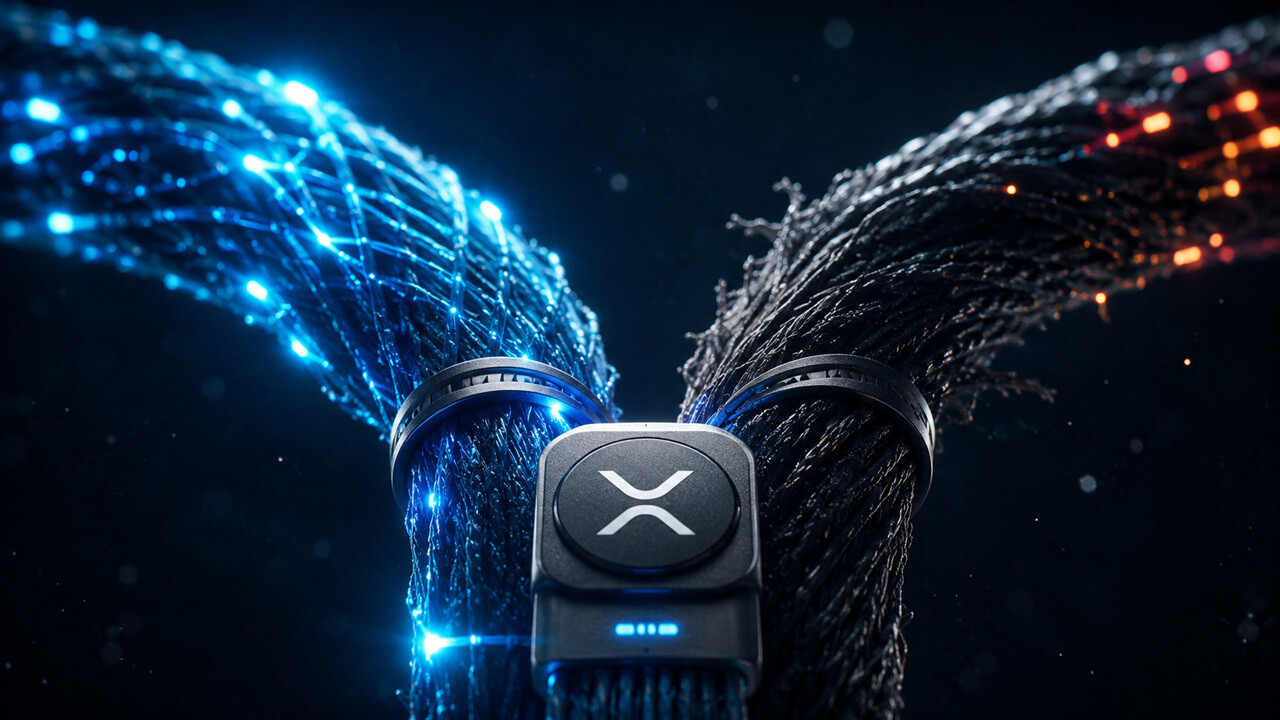
XRPL node network visualization
“"Consensus legitimacy on XRPL flows through trust lists and validator coordination, not through the number of unupgraded nodes."”
On-Chain Data
On-Chain Data
Approval Threshold: More than 80% of trusted validators must support an amendment for two weeks for it to activate.
Amendment Blocking: Servers that do not upgrade lose the ability to determine ledger validity, submit or process transactions, participate in consensus, and vote on future amendments.
UNL Overlap: XRPL documentation cites research showing competing UNLs may need 90% overlap in the worst case to prevent a fork.
Fork Layers: Schwartz identifies five elements needed for a credible fork: old-rule validators, a rival UNL, old-rule code, infrastructure support, and market recognition.
on-chain data analytics dashboard
Market Impact
For exchanges, wallets, explorers, and infrastructure operators still running pre-3.1.3 software, the May 27 deadline is operationally critical. Falling behind means exclusion from the canonical ledger until the operator updates. Amendment-blocked infrastructure loses access to the upgraded chain and lacks the coordination infrastructure to anchor a functional rival.
A credible fork would require a dissenting group to gather validators willing to keep producing ledgers under the old rules. Without validators, there is no ledger stream to follow. They would then need a competing UNL that servers can configure, a code distribution preserving the old rules with defaults pointing to the rival UNL, and infrastructure support from wallets, exchanges, explorers, and apps to make the old-rule ledger accessible and tradable.
The distance between having unupgraded nodes and having a functional rival chain is enormous. A large share of unupgraded non-validator nodes reflects infrastructure lag without implying anything about the canonical ledger's trajectory.
Your Alpha
Your Alpha
1For node operators: Upgrade to rippled 3.1.3 before May 27 to avoid amendment blocking and maintain consensus participation.
2For exchanges: Verify your infrastructure is updated to continue processing XRPL transactions without interruption. A blocked exchange would lose deposit and withdrawal capabilities.
3For investors: Do not confuse unupgraded nodes with an imminent fork. Network legitimacy depends on UNL alignment and economic adoption, not node count.
crypto trader analyzing charts
Next Catalyst
The activation of fixCleanup3_1__3 on May 27 is the immediate event. But the real catalyst to watch is how the infrastructure ecosystem responds: which exchanges upgrade on time, how many validators show support, and whether any dissident coordination emerges. XRPL documentation suggests rival UNLs need up to 90% overlap to avoid a fork, making a split extremely unlikely without broad consensus.
Beyond this upgrade, the market should observe how other protocols handle similar situations. XRPL's model — based on curated UNLs and high validator thresholds — offers lessons in on-chain governance that could apply to other chains.
The Bottom Line
The Bottom Line
The May 27 upgrade on XRPL is not just technical maintenance; it's a demonstration of how validators and markets decide a chain's fate. A real fork requires five layers beyond unupgraded nodes: validators, rival UNL, code, infrastructure, and market recognition. The lesson for the crypto ecosystem is clear: protocol legitimacy is measured not by node count, but by coordinated trust and economic adoption. Position yourself in infrastructure aligned with the canonical consensus.
Deeper Analysis: Governance Implications
XRPL's model contrasts sharply with proof-of-stake blockchains where voting weight is proportional to stake. On XRPL, trust is explicit and curated, reducing Sybil attack risk but introducing dependence on UNL operators' reputation. This has implications for decentralization: while anyone can run a validator, only those included in widely adopted UNLs have real influence. XRPL documentation indicates that UNL overlap must be high (up to 90%) to avoid forks, suggesting the network naturally tends toward consensus.
For investors, this means governance disputes on XRPL are less likely to result in forks than on chains like Bitcoin or Ethereum. The barrier to a credible fork is much higher, which can be seen as a strength (stability) or weakness (resistance to change), depending on perspective. In any case, the market should monitor UNL composition and software adoption speed as key indicators of network health.
Historical Context: Lessons from Past Forks
Historical Context: Lessons from Past Forks
To understand the magnitude of what Schwartz describes, it's worth recalling famous forks like Bitcoin Cash (2017) or Ethereum Classic (2016). In both cases, there was a significant group of miners/validators, exchanges, and community supporting the split. On XRPL, the absence of mining and reliance on curated UNLs makes coordination even harder. A fork would require not just code and nodes, but also exchanges listing both chains and users recognizing the new chain as legitimate. Without that market recognition, the forked chain lacks value.
Schwartz has noted that even if a group managed to gather validators for a rival chain, lack of liquidity and infrastructure support would doom it to irrelevance. Therefore, the May 27 upgrade is not just a technical event but a test of XRPL ecosystem cohesion.
Expanded On-Chain Data
Adoption speed of rippled 3.1.3: Historically, rippled versions reach over 90% adoption among validators within two weeks before an amendment activates. Monitoring this can anticipate amendment blocking likelihood.
UNL distribution: The default XRPL Foundation UNL covers approximately 95% of trusted validators. Any rival UNL would need significant overlap to maintain chain coherence.
Exchange transaction volume: An increase in XRP volume on exchanges before May 27 could indicate uncertainty or arbitrage activity related to the upgrade.
These points reinforce the thesis that network legitimacy is based on trust coordination, not node count.
Final Conclusion
Final Conclusion
The May 27 upgrade is a reminder that on blockchains with curated UNLs, power resides in explicit trust and coordination. For market participants, the lesson is clear: do not confuse unupgraded nodes with an imminent fork. The real action is in validator alignment, exchanges, and community. Position yourself in infrastructure that follows the canonical consensus and monitor UNLs as the true thermometer of network health.