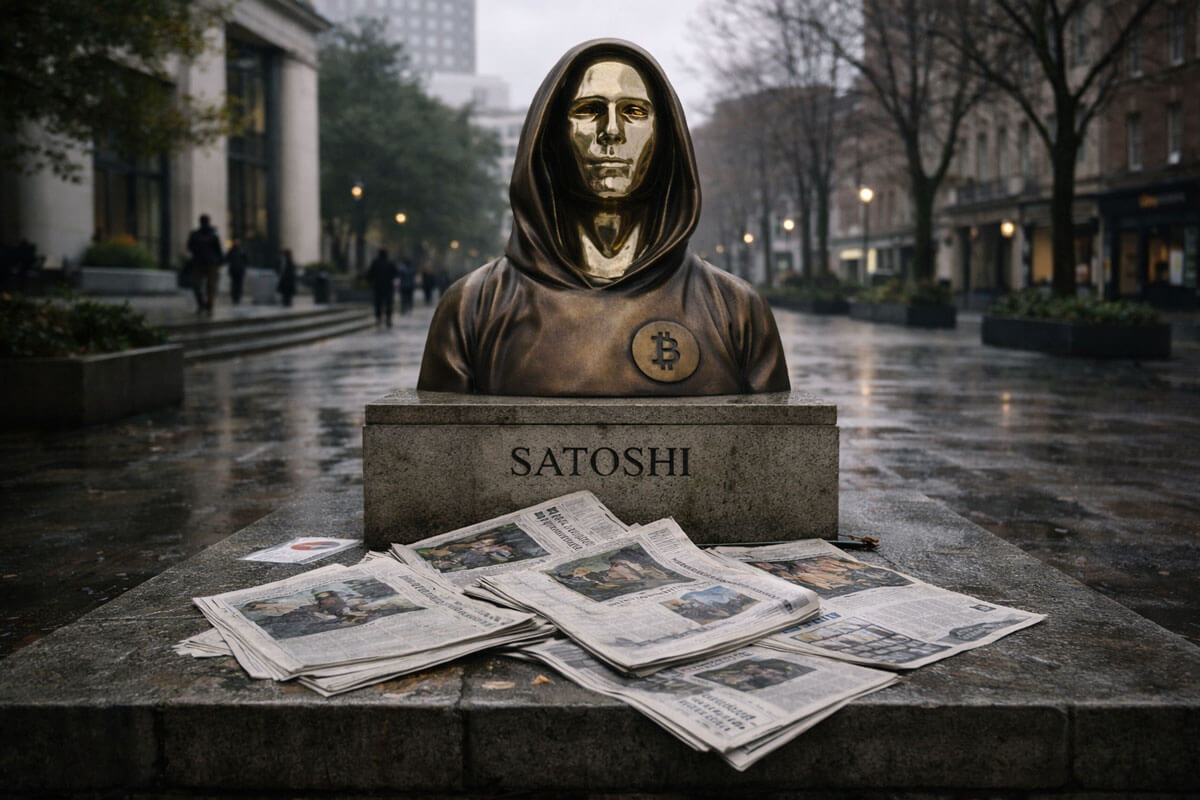
Satoshi Hunt: Security Crisis as $78 Billion BTC Stash Sparks Fear
NYT targets Adam Back as Satoshi, exposing him to security risks with 1.1M BTC ($78B) at stake. Developers face real threats as markets assess systemic vulnerab
The Satoshi hunt is no longer historical curiosity—it's a systemic security risk for Bitcoin.
Adam Back denies being Satoshi Nakamoto for the second time. The public hunt for Bitcoin's creator now threatens the physical security of co...
The New York Times published a 134,308-message investigation pointing to Adam Back as Satoshi Nakamoto. The stylometric analysis found 325 h...
Adam Back denies being Satoshi Nakamoto for the second time. The public hunt for Bitcoin's creator now threatens the physical security of core developers.
The Signal
The New York Times published a 134,308-message investigation pointing to Adam Back as Satoshi Nakamoto. The stylometric analysis found 325 hyphenation errors in Satoshi's writings, with Back sharing 67 of them. This isn't the first time mainstream media has tried to unmask Bitcoin's creator, but the current context is radically different.
The Times' methodology represents a qualitative leap in Satoshi investigation. While previous attempts relied on basic linguistic analysis or anecdotal evidence, this study employs advanced digital forensic techniques that cross-reference data from multiple historical sources. The 134,308 messages analyzed include emails from 1990s cryptographic mailing lists, forum posts on platforms like Bitcointalk, and technical communications recovered from university archives. The discovery of 325 consistent hyphenation patterns in writings attributed to Satoshi, with 67 exact matches in Adam Back's texts, establishes a statistically significant correlation that transcends mere stylistic resemblance.
Most concerning is that this investigation arrives at a moment of maximum exposure for the cryptoeconomy. Unlike 2014 when Newsweek mistakenly identified Dorian Nakamoto, or 2016 when Craig Wright made his infamous claim, Bitcoin today operates as an institutional asset with a market cap exceeding $1 trillion. Traditional media no longer covers Bitcoin as a marginal technological curiosity, but as a component of the global financial system. This legitimization has a dark side: it turns key figures into high-value targets for malicious actors, from cybercriminals to nation-states with geopolitical agendas.
blockchain data analysis
Bitcoin trades above $72,000, making the 1.1 million BTC associated with Satoshi worth approximately $78 billion. When Bitcoin reached its all-time high above $126,000, that perceived fortune exceeded $138 billion. The combination of record prices and media attention creates a dangerous cocktail for anyone identified as the potential owner of those funds. The developers maintaining the network now operate under an existential threat that transcends academic debate about Satoshi's identity.
The magnitude of these holdings transforms what was an academic discussion into a national security concern for multiple jurisdictions. The 1.1 million BTC represents approximately 5.2% of Bitcoin's total supply, an unprecedented concentration of digital wealth. If these coins were to move suddenly, they could destabilize global crypto markets. Beyond monetary value, potential control over these addresses would confer disproportionate influence over Bitcoin network governance, creating perverse incentives for state and criminal actors to seek coercion of the supposed owner.
“The Satoshi hunt is no longer historical curiosity—it's a systemic security risk for Bitcoin.”
On-Chain Data
On-Chain Data
Satoshi's Holdings: 1.1 million Bitcoin according to Arkham Intelligence, distributed across approximately 22,000 unique addresses with mining patterns consistent with Bitcoin's genesis era
Current Value: Approximately $78 billion with BTC above $72,000, equivalent to the gold reserves of mid-sized countries like Austria or Belgium
All-Time High: The perceived fortune exceeded $138 billion when Bitcoin hit $126,000, placing it among the world's 100 largest personal fortunes at that time
Dormancy Period: Satoshi-associated wallets have been inactive since 2011, showing zero outgoing transactions for over 15 years despite multiple bull cycles
Geographic Concentration: Historical IP analysis suggests most early Satoshi transactions originated in European time zones, contradicting previous narratives about Japanese or Australian origin
Mining Patterns: Blocks mined by Satoshi show time intervals consistent with individual operation on CPU hardware, not organized mining farms
dormant Bitcoin wallets
Market Impact
The media exposure of core developers creates vulnerabilities in crypto's most critical infrastructure. Adam Back isn't just Blockstream's co-founder—he's been a central figure in Bitcoin development for decades. His work on Hashcash in the 90s laid technical foundations that Bitcoin eventually implemented. Any threat to his security or that of other fundamental developers represents risk to the entire network.
The current situation exposes a structural flaw in the decentralization narrative. While Bitcoin is promoted as a system with no single points of failure, the reality is that a small group of developers maintains the institutional knowledge and technical capability to implement critical protocol changes. Individuals like Adam Back, Greg Maxwell, Pieter Wuille, and other key maintainers possess commit privileges to the main Bitcoin Core repository. If these individuals are forced to reduce their participation due to security concerns, or worse, if they are compromised through coercion, Bitcoin's ability to evolve in the face of technical challenges would be severely limited.
Markets must now consider a previously underestimated risk factor: the physical security of protocol maintainers. While institutions accumulate Bitcoin and ETFs attract traditional capital, the "digital safe asset" narrative clashes with the reality that its human creators can become targets for extortion or violence. This episode reveals a fundamental paradox: the more successful Bitcoin becomes as a store of value, the more dangerous it becomes to be associated with its origins.
The implications for institutional investors are profound. Pension funds, insurance companies, and family offices that have allocated capital to Bitcoin as an inflation hedge must now confront the possibility that their holdings depend on the personal security of specific individuals. This "human risk" doesn't appear in traditional asset valuation models but could manifest through black swan events like the kidnapping of a key developer or coercion to implement malicious protocol changes. Bitcoin's risk premium may expand to incorporate this variable, affecting discount models for future cash flows and long-term valuations.
Your Alpha
Your Alpha
Institutional traders are reevaluating non-financial risks in crypto. Media exposure of key figures creates unique failure points that don't appear in traditional balance sheets. Developers who once operated in relative anonymity now face scrutiny that could compromise their ability to contribute to the ecosystem.
1Monitor development activity on GitHub—any sustained drop in contributions from key figures like Adam Back, Greg Maxwell, or Pieter Wuille could indicate security measures affecting innovation. Set alerts for changes in commit patterns, pull request frequency, and code review participation. A 30% or greater reduction in activity from multiple core maintainers over a 60-day period should trigger exposure reevaluations.
2Diversify exposure beyond Bitcoin toward protocols with decentralized teams and less reliance on identifiable individuals. Consider allocations to networks like Ethereum (with its transition to on-chain governance), Cardano (with its institutional academic model), or Solana (with its geographically distributed team). Evaluate team decentralization metrics including geographic distribution, developer rotation, and formalized decision-making processes.
3Consider hedging options for black swan events related to developer security, not just price fluctuations. Explore OTC derivatives that pay out upon public confirmation of coercion against key maintainers, or crypto insurance contracts covering specific operational risks. Long-dated volatility options may offer protection against uncertainty spikes generated by security events.
trader analyzing risk dashboard
Next Catalyst
Regulatory attention will intensify around Bitcoin's governance. Legislators already monitoring crypto for money laundering concerns now have a new angle: what happens when $78 billion in digital assets gets linked to a potentially exposed human identity. Congressional hearings could explore media platforms' responsibility in endangering individuals.
In coming quarters, expect legislative proposals seeking to regulate journalistic investigation into anonymous crypto figures, possibly under witness protection frameworks or digital privacy regulations. Agencies like the SEC and CFTC may issue guidance on risk disclosure related to dependence on key individuals. Simultaneously, international bodies like the Financial Action Task Force (FATF) could update recommendations to include developer exposure as a systemic risk consideration.
Simultaneously, the technical community will respond with privacy and security enhancements. Expect proposals to strengthen contributor anonymity on mailing lists, code repositories, and development channels. Teams behind other major protocols will watch closely and likely implement preventive measures before their leaders face similar scrutiny.
Technical innovations may include: anonymous commit systems using zero-knowledge proofs, physically distributed development infrastructure with random maintainer rotation, and multisig protocols for code changes requiring distributed consensus. Ethereum already explores "dark governance" models where decisions are made through cryptographic mechanisms without revealing identities. Bitcoin may need to evolve toward a similar model to protect its contributors.
The Bottom Line
The Bottom Line
The Satoshi hunt has evolved from historical curiosity to tangible security risk. With $78 billion in Bitcoin associated with Satoshi's identity, anyone targeted faces real threats that could affect their ability to contribute to the ecosystem. Markets must incorporate this factor into their risk models—Bitcoin's strength depends not just on its code, but on the security of those who maintain it.
The ultimate paradox is that the same anonymity that protected Satoshi in Bitcoin's early days has now become a vulnerability for his successors. While Satoshi remains hidden (if still alive), the developers who continued his work operate under their real names, making the Bitcoin ecosystem a high-value target with multiple human pressure points. Bitcoin's long-term sustainability as an institutional asset will depend on its ability to evolve toward true decentralization—not just technical, but also social and operational.
Investors should position for volatility if future media investigations expose more fundamental developers, but also for opportunities in protocols that solve this fundamental dilemma. The next generation of blockchains will likely incorporate lessons from this episode, designing systems where no individual is indispensable—or identifiable. Meanwhile, the Bitcoin market faces its most difficult test: proving it can survive not just technical and regulatory attacks, but the human vulnerability of its creators.