DeFi Pivot: Wall Street's $330 Billion On-Chain Squeeze Intensifies as
Wall Street is capturing $330 billion in on-chain capital with regulated platforms offering 24/7 trading and instant settlement. DeFi protocols must prove compo
The contest is no longer over whether finance will move on-chain—that battle is won—but over who captures the capital once it does and under what structural terms.
NYSE builds 24/7 tokenized platforms while Drift loses $285 million in an exploit. The battle for on-chain finance's future intensifies as W...
Wall Street spent the first quarter of 2026 systematically dismantling DeFi's competitive advantage through a coordinated strategy combining...
NYSE builds 24/7 tokenized platforms while Drift loses $285 million in an exploit. The battle for on-chain finance's future intensifies as Wall Street deploys regulated infrastructure that threatens to marginalize traditional DeFi protocols if they cannot demonstrate sustainable competitive advantages beyond mere composability.
The Signal
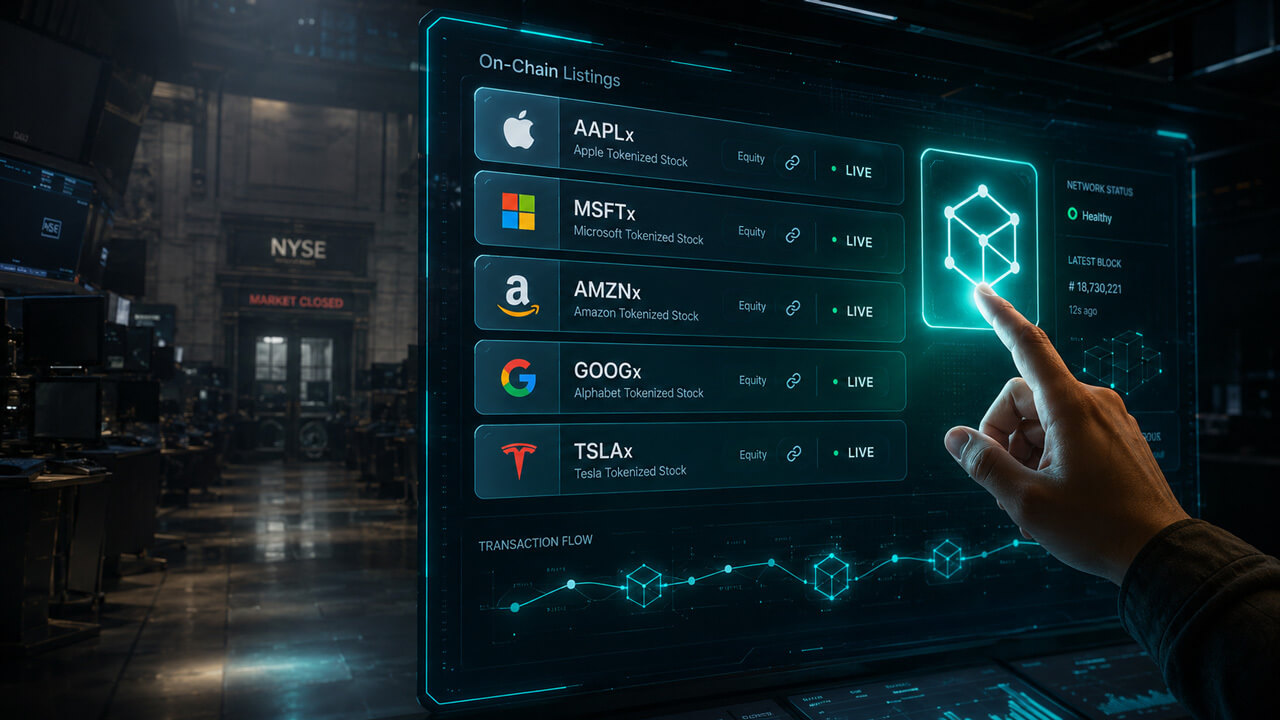
Wall Street spent the first quarter of 2026 systematically dismantling DeFi's competitive advantage through a coordinated strategy combining technological innovation with favorable regulatory frameworks. In January, Intercontinental Exchange (ICE) announced NYSE was building a tokenized securities platform with 24/7 operations, instant settlement, dollar-based order sizing, and stablecoin funding. Most significantly, Bank of New York Mellon and Citigroup would provide tokenized deposits for clearinghouse funding outside traditional banking hours. This move represents a fundamental shift: NYSE is moving toward "continuous" settlement, forever eliminating the temporal limitations that have defined traditional markets for centuries.
institutional trading floor with screens displaying on-chain data
In February, WisdomTree launched 24/7 trading and instant settlement for tokenized money-market fund shares under specific SEC regulatory relief. This regulatory precedent is crucial because it establishes that tokenized financial products can operate under special regimes recognizing the operational advantages of blockchain technology. In March, the Fed, FDIC, and OCC issued a historic joint statement establishing that eligible tokenized securities should receive the same capital treatment as their non-tokenized counterparts, explicitly describing the framework as "technology-neutral." Immediately following, the SEC approved Nasdaq's proposal to trade certain securities in tokenized form, with settlement through the Depository Trust Company (DTC). NYSE and Securitize closed the quarter with a strategic partnership to build digital transfer-agent infrastructure around institutional operating standards, thus completing a coherent regulatory and technological ecosystem.
“The contest is no longer over whether finance will move on-chain—that battle is won—but over who captures the capital once it does and under what structural terms.”
On-Chain Data
On-Chain Data
Analysis of on-chain data reveals the magnitude of capital at stake and the speed at which the financial landscape is transforming:
Stablecoins: Dominate the on-chain capital pool at roughly $317 billion, representing 95.8% of the total. This concentration is significant because stablecoins are the natural bridge between traditional finance and blockchains, and their predominance creates an immediately accessible liquidity base for institutional platforms.
Tokenized Treasuries: Represent nearly $13 billion in on-chain assets, with 47% growth in Q1 2026 alone. This segment is particularly attractive to institutions due to its familiar risk profile and natural alignment with existing regulatory requirements.
Tokenized Stocks: Reach $1 billion in total value, a 215% increase since year-start. Although the smallest segment, its accelerated growth rate indicates growing institutional appetite for exposure to broader asset classes in tokenized form.
Total Pool: $331 billion in capital available for institutional capture, with an 18.3% quarterly compounded growth rate since 2025. This organic growth, combined with the newly established regulatory infrastructure, creates ideal conditions for exponential acceleration of institutional adoption.
on-chain capital chart showing quarterly growth and category distribution
Market Impact
The regulatory and technological sequence of Q1 2026 has fundamentally altered DeFi's competitive position. Regulated exchanges, broker-dealers, and bank-backed clearinghouses can now package 24/7 trading and on-chain settlement inside a supervised market structure, with matching regulatory capital treatment. This combination eliminates the primary operational advantage DeFi had over traditional finance: continuous availability and settlement efficiency.
The base pool of on-chain capital these moves target already exceeds $330 billion, but this is only the capital currently available in native digital format. The implications run deeper: once institutional infrastructures are fully operational, they can attract orders of magnitude more traditional capital currently residing off-chain. The $317 billion in stablecoins, $13 billion in tokenized Treasuries, and $1 billion in tokenized stocks represent just the tip of the iceberg of what could migrate on-chain over the next 12-24 months.
Composability remains DeFi's theoretical distinct advantage: the ability to build interconnected financial products on shared, permissionless infrastructure where any protocol can connect directly to any other on open terms. This genuinely DeFi-native feature enables innovations like yield farming, recursive leverage, and complex structured products that would be impossible or prohibitively expensive in traditional infrastructures. However, institutional platforms' architecture presents fundamental limitations: Nasdaq-approved tokenized securities still settle through DTC, are subject to exchange surveillance, and operate under existing order types and reporting frameworks. WisdomTree's tokenized fund sits inside a traditional broker-dealer model. NYSE designed its tokenized platform around transfer agents and institutional operating standards. All these architectures require a central gatekeeper to approve downstream connections, severely limiting the composable innovation that defines DeFi.
Your Alpha
Your Alpha
The value of composability as a competitive moat depends entirely on whether institutional capital allocators believe surrounding controls are mature enough to contain localized failures without systemic contagion. Drift's exploit exposed this dependency in the most direct way possible, revealing critical vulnerabilities even in sophisticated DeFi protocols. Drift confirmed the $285 million attack exploited durable nonces and a takeover of Security Council administrative powers through a compromise of the access-control layer. DefiLlama classified the incident as a hack driven by compromised admin access and price manipulation, with Drift's total value locked (TVL) falling from roughly $550 million to below $250 million within hours.
1Reevaluate exposure to protocols with centralized control layers: Exploits like Drift's demonstrate that even the most sophisticated DeFi protocols can have single points of failure in their governance structures. Seek protocols implementing truly decentralized access controls, mandatory timelock periods for administrative changes, and multisig governance mechanisms with high thresholds. Prioritize protocols that have completed exhaustive security audits from recognized firms and maintain active bug bounty programs.
2Monitor TVL migration toward institutional platforms: The $331 billion in currently available on-chain capital represents just the beginning of what could become a massive migration. Establish tracking metrics for TVL on institutional platforms like NYSE Digital, WisdomTree Digital, and similar products. Pay particular attention to relative growth rates: if TVL on institutional platforms consistently grows faster than on pure DeFi protocols over multiple quarters, this would indicate a structural shift in capital preferences.
3Prioritize protocols with real defensive advantages beyond composability: Pure composability is no longer sufficient as a unique value proposition. Protocols must demonstrate cost, efficiency, or innovation advantages that regulated platforms cannot easily replicate due to architectural or regulatory constraints. Look for protocols offering: (a) significant capital efficiencies (lower margin requirements, better collateral utilization), (b) genuinely innovative financial products impossible in traditional infrastructures, or (c) cross-chain integrations creating network effects difficult to replicate.
DeFi protocol dashboard showing security metrics, TVL, and growth
Next Catalyst
The regulatory framework continues evolving rapidly, with several critical developments scheduled for coming months. The March joint statement from the Fed, FDIC, and OCC establishing capital-neutral treatment for tokenized securities created an important precedent, but the agencies explicitly warned they may revise this framework based on operational experience and risk evolution. The SEC maintains discretionary authority over tokenized product approvals, and any change in regulatory leadership or policy priorities following the 2026 elections could significantly alter the landscape.
For DeFi, the immediate next catalyst will be how protocols respond to the dual competitive pressure from institutional platforms and exposed security vulnerabilities. If regulated venues can offer blockchain-based trading and settlement without DeFi's governance and control-layer risks, open protocols must convincingly prove why institutions should accept the added exposure. The response will determine whether DeFi remains a niche for speculative and retail capital, or becomes a fundamental layer for global finance. Protocols implementing significant improvements in security, transparency, and voluntary regulatory compliance will be better positioned to capture institutional capital.
The Bottom Line
The Bottom Line
Wall Street is executing a systematic capture of on-chain capital with regulated infrastructure that precisely mitigates the risks that make institutions wary of DeFi: exposure to exploits, regulatory uncertainty, and operational complexity. The $331 billion in stablecoins, Treasuries, and tokenized stocks represents just the tip of the iceberg—traditional institutions control approximately $450 trillion in global financial assets, and even a small fraction of this migrating on-chain would exceed the current DeFi ecosystem's size by orders of magnitude.
DeFi faces an existential crossroads: it must prove composability and open innovation justify control-layer risk exposure, or face increasing marginalization as finance moves on-chain through institutional channels. The protocols that survive and thrive will be those developing real defensive advantages—whether through superior security architectures, demonstrable capital efficiencies, or genuinely innovative financial products—not just interoperability promises. Position strategically in protocols with solid technical fundamentals, robust governance, and differentiated value propositions, while closely monitoring capital migration toward institutional platforms.