DeFi Crisis: $13B Loss Exposes Fragility Despite Kelp Rescue
DeFi lost $13B in TVL as KelpDAO's 69,550 ETH rescue highlights systemic risk. The incident reveals concentration vulnerabilities and governance challenges ahea
The 69,550 ETH rescue closes 92.5% of the gap, but pending governance votes keep the risk alive.
DeFi lost $13 billion this month. The KelpDAO rescue shows both the best and worst of the ecosystem.
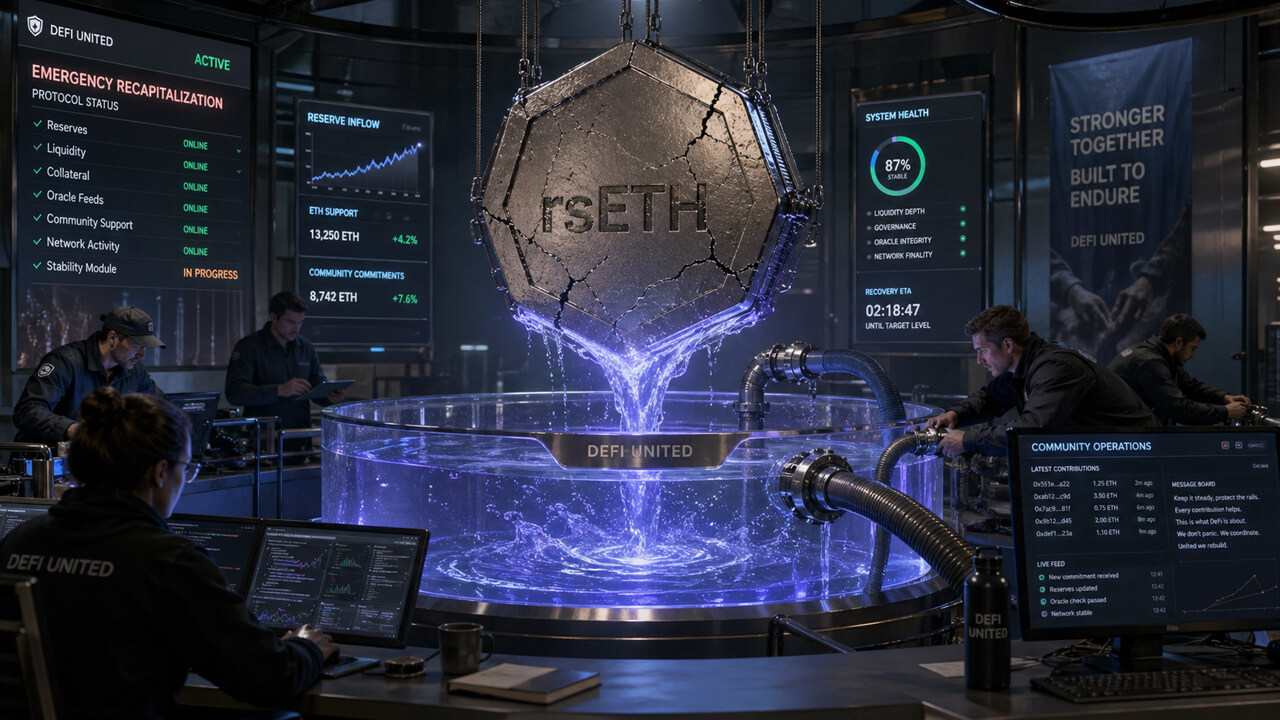
The official DeFi United site shows over 69,550 ETH raised from 222 wallets across 1,623 transfers, all aimed at restoring rsETH backing. It...
DeFi lost $13 billion this month. The KelpDAO rescue shows both the best and worst of the ecosystem.
The Signal
The official DeFi United site shows over 69,550 ETH raised from 222 wallets across 1,623 transfers, all aimed at restoring rsETH backing. It's DeFi's first lender of last resort, assembled without a regulator or central bank.
DeFi United dashboard
Aave's governance proposal puts the original rsETH shortfall at approximately 163,183 ETH. Recoveries and freezes — including 43,168 ETH from Kelp, 30,766 ETH frozen by the Arbitrum Security Council, up to 12,323 WETH from Aave liquidations, and 1,845 WETH from Compound — reduce the residual funding gap to about 75,081 ETH. DeFi United currently covers roughly 92.5% of that residual, leaving approximately 5,632 ETH uncovered.
“The 69,550 ETH rescue closes 92.5% of the gap, but pending governance votes keep the risk alive.”
On-Chain Data
On-Chain Data
Original rsETH shortfall: 163,183 ETH per Aave's governance proposal.
ETH raised by DeFi United: 69,550 ETH from 222 wallets across 1,623 transfers.
Residual gap: 5,632 ETH after recoveries and 92.5% coverage.
Total coverage (including Arbitrum): 100,200 ETH committed against a 116,500 ETH target, roughly 86%.
TVL drop: $13 billion in 48 hours; Aave lost $8.45 billion in TVL.
rsETH recovery waterfall chart
Market Impact
WETH utilization on Aave hit 100% as users rushed for the exits, simultaneously pushing USDT and USDC pools to full utilization. The exploit leveraged a 1-of-1 configuration with LayerZero Labs as the sole verifier for the rsETH bridge. Galaxy Research found that the attacker unlocked 116,500 rsETH from Ethereum mainnet escrow, then used the stolen tokens as collateral across Aave, Compound, and Euler to borrow an estimated $236 million in WETH and wstETH.
LayerZero characterized the attack as 'RPC poisoning' targeting its decentralized validator network (DVN), stopping short of identifying a flaw in the LayerZero protocol itself. However, the bridge route still depended on LayerZero Labs as the sole verifier, concentrating trust in a single point. LayerZero appears as 'Confirmed, TBD' on DeFi United, making its undisclosed contribution one of the most consequential missing numbers.
Your Alpha
Your Alpha
1Monitor governance votes: Mantle (30,000 ETH), Aave DAO (25,000 ETH), and EtherFi (5,000 ETH) are the largest pending contributions. Any rejection could reopen the gap.
2Assess bridge concentration risk: The 1-of-1 configuration with a single verifier is a systemic risk. Look for protocols with multiple verifiers or decentralized mechanisms.
3Watch the Lido precedent: Its 2,500 ETH contribution opens a debate about covering losses outside its own protocol. This could set a precedent for future rescues.
trader analyzing DeFi portfolio
Next Catalyst
Governance votes from Mantle, Aave DAO, and EtherFi are imminent. The outcome will determine whether the 5,632 ETH gap closes completely. Additionally, LayerZero's contribution, though confirmed, remains undisclosed in amount, adding uncertainty.
Market participants are watching whether this rescue sets a cooperative precedent or if lack of transparency in contributions erodes trust. Lido's decision could also influence how other protocols handle external losses in the future.
The Bottom Line
The Bottom Line
DeFi survived its biggest stress test with an unprecedented community rescue, but structural fragility remains. The concentration of trust in a single verifier and pending votes remind us that decentralization is still a work in progress. Position cautiously as governance defines the next chapter.
Deeper Analysis: Systemic Implications
The KelpDAO incident is not an isolated event; it reveals deep vulnerabilities in DeFi's architecture. The reliance on a single bridge verifier, such as LayerZero Labs, creates a central point of failure that can be exploited. Although LayerZero claimed the attack was 'RPC poisoning' and not a protocol flaw, the reality is that the 1-of-1 configuration allowed the attacker to compromise the entire system. This underscores the need for more robust verification mechanisms, such as multi-threshold or zero-knowledge proofs.
Moreover, the coordinated response from DeFi United, while effective, raises questions about emergency governance. Should DAOs have the ability to mobilize funds so quickly without a full vote? The speed of action averted a larger crisis, but it could also set a precedent for ad-hoc interventions that bypass established governance processes. The balance between efficiency and decentralization remains a challenge.
Historical Context
Historical Context
This rescue echoes past events like the Terra collapse in 2022, where the lack of a coordinated rescue mechanism led to catastrophic losses. In contrast, DeFi United's response shows growing maturity in the community, but it also reveals that protocols are still unprepared for tail events. The $13 billion TVL drop in 48 hours is comparable to the volatility seen during the FTX collapse, indicating that DeFi remains highly sensitive to confidence shocks.
The fact that Aave lost $8.45 billion in TVL underscores how lending protocols are particularly vulnerable to bridge attacks. The interconnectedness of protocols means that a failure in one bridge can quickly propagate across the ecosystem. This event will likely accelerate the adoption of safer bridge solutions, such as native bridges or those with decentralized verification.
Future Outlook
Looking ahead, the industry needs to rethink security models. Aave's proposal to cover the remaining deficit with DAO funds could set a standard for shared responsibility, but it could also incentivize risky behavior if protocols expect to be bailed out. It will be crucial for governance communities to establish clear limits on when and how treasury funds can be used for rescues.
Furthermore, the role of 'lender of last resort' in DeFi could become institutionalized. DeFi United demonstrated that a rapid response is possible, but the lack of transparency in contributions (such as LayerZero's) must be addressed. The creation of a decentralized insurance fund, similar to the FDIC in traditional banking, could be a natural evolution. However, this would require unprecedented coordination between protocols and robust governance to avoid moral hazard.
In summary, the KelpDAO rescue is a milestone in DeFi history. It shows that the community can unite in times of crisis, but it also exposes structural weaknesses that must be addressed for DeFi to reach its full potential. Investors and developers should take note: decentralization is not just an ideal but a practical necessity for system resilience.