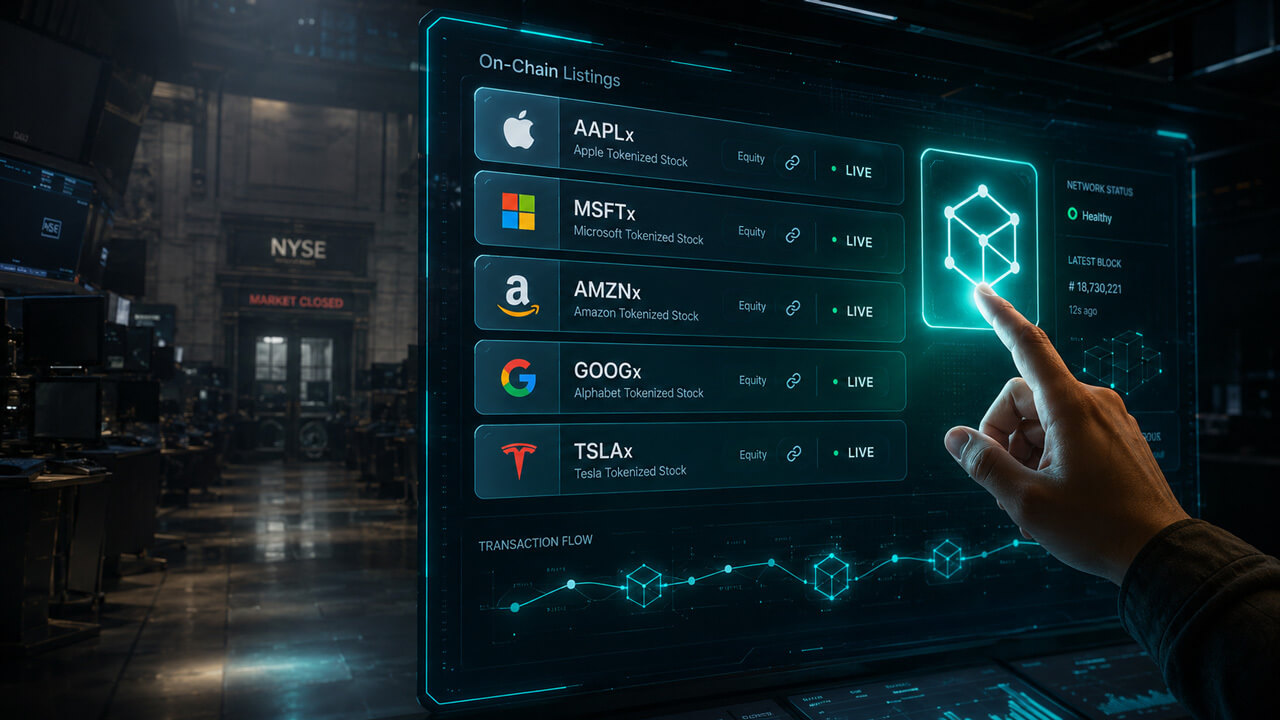
The SEC has slammed the brakes on its highly anticipated 'innovation exemption' for tokenized stocks, pushing back the release of the framework as it weighs input from traditional exchanges and other market players, according to Bloomberg reporting. Chair Paul Atkins was preparing to unveil the plan this week, but feedback from Nasdaq, Cboe, and CME has forced a delay. The exemption would have allowed third-party digital tokens representing shares of companies like Apple or Tesla to trade 24/7 on decentralized platforms, bypassing traditional exchanges.
The Signal
The SEC, under Chair Paul Atkins, was ready to release the so-called innovation exemption as soon as this week. The framework would create a new regulatory pathway for digital tokens linked to publicly traded company shares to trade on decentralized crypto platforms — 24 hours a day, seven days a week — bypassing the constraints of traditional stock exchanges. The exemption is part of Atkins' broader 'Project Crypto' initiative, which aims to relax existing crypto restrictions in line with the Trump administration's pro-crypto agenda. However, traditional exchanges pushed back hard, with the World Federation of Exchanges — whose members include Nasdaq, Cboe, and CME Group — warning in a November 2025 letter that such exemptions could 'dilute' existing investor protections and 'distort' competition.

The SEC was reportedly leaning toward permitting third-party tokens — digital representations of stocks like Apple, Nvidia, or Tesla — to be issued and traded without the consent of the underlying public companies. This means outside actors, not the issuers themselves, could create blockchain-based wrappers tracking a company's share price and list them on decentralized finance (DeFi) platforms. These tokens may not carry traditional shareholder rights like voting or dividends, though the SEC is reportedly considering requiring platforms to provide those rights or risk delisting. This approach contrasts with Nasdaq's alternative model, which received SEC approval in March 2026 for its own tokenized securities proposal, keeping all trades on-exchange with full shareholder rights intact, built on the DTCC's enterprise blockchain.
“The tokenization of stocks promises 24/7 liquidity but threatens to fragment markets and dilute investor protections.”
On-Chain Data

- Market size: While no official data exists, the real-world asset (RWA) tokenization market has surpassed $15 billion in total value locked (TVL), according to industry sources. Projects like Ondo Finance and BlackRock's BUIDL fund have driven growth, though tokenized stocks remain a small fraction.
- Exchange pushback: The World Federation of Exchanges — whose members include Nasdaq, Cboe, and CME Group — warned the SEC in a November 2025 letter that such exemptions could 'dilute' existing investor protections and 'distort' competition. The letter also highlighted risks of liquidity fragmentation and regulatory arbitrage.
- Nasdaq's alternative: Nasdaq received SEC approval in March 2026 for its own tokenized securities proposal, which keeps all trades on-exchange with full shareholder rights intact, built on the DTCC's enterprise blockchain. This centralized model contrasts with the decentralized approach of the exemption.
- Liquidity fragmentation: The exemption would allow multiple third-party issuers to create tokens for the same underlying stock, potentially dispersing liquidity across dozens of pools. For example, if five issuers create Apple tokens, liquidity pools could split, leading to wider spreads and higher slippage.

Market Impact
The delay is a win for traditional exchanges that see their business model threatened. Tokenized stocks on DeFi could undercut Nasdaq and Cboe's fee income while offering investors 24/7 access without intermediaries. However, the risk of liquidity fragmentation is real: if dozens of issuers create tokens for the same stock, liquidity pools become diluted, leading to wider spreads and higher slippage for traders.
For DeFi protocols, the exemption was a golden opportunity to attract institutional capital. Platforms like Uniswap or dYdX could list these tokens, drawing traders who want to operate outside Wall Street hours. But the delay cools enthusiasm and gives regulators time to fine-tune details — or potentially kill the plan altogether if opposition mounts. Some protocols have already started building infrastructure, such as Synthetix with its synthetic assets, but regulatory clarity remains a hurdle for mass adoption.
Retail investors stand to benefit from tighter spreads and greater accessibility, but they also face risks: the lack of voting rights and dividends could turn these tokens into pure speculation vehicles, not true representations of equity ownership. The SEC's consideration of requiring platforms to provide those rights could mitigate this, but it also adds operational complexity.
Your Alpha

- 1Monitor regulatory timelines. The delay is not a cancellation. The SEC will likely publish the exemption in the coming weeks or months, but with modifications. Watch for statements from Chair Atkins and public comments from exchanges. A possible timeline: proposed rule in 4-6 weeks, followed by a public comment period.
- 2Evaluate prepared DeFi projects. Some protocols already have infrastructure for tokenizing stocks. Look for those with partnerships with regulated custodians or those offering tokenized voting rights. Examples: Ondo Finance (partnered with BlackRock), and projects using oracles like Chainlink for accurate pricing.
- 3Diversify into RWA. Real-world asset tokenization is a 2026 trend. Beyond stocks, consider tokenized bonds, real estate, and commodities. The delay in stocks might accelerate innovation in other asset classes. For instance, tokenized Treasury bonds already exceed $2 billion in TVL.

Next Catalyst
The main event to watch is the publication of the final regulatory framework. The SEC could issue a proposed rule within 4-6 weeks, followed by a public comment period. Additionally, the U.S. midterm elections in November 2026 could influence the pace of crypto reforms. If Republicans retain control of Congress, pro-crypto agenda is likely to accelerate.
Another catalyst is the response from traditional exchanges. If Nasdaq and Cboe launch their own tokenized products, they could pressure the SEC to accelerate or modify the exemption. The competition between centralized and decentralized models will define the future of capital markets. Additionally, potential approval of tokenized stock ETFs could be a game-changer.
The Bottom Line

The SEC's delay of the tokenized stock exemption signals that regulatory battles are far from over. While Chair Atkins' pro-crypto stance remains, pushback from entrenched market players is powerful. For investors, tokenized stocks remain a long-term opportunity, but near-term uncertainty demands caution. Position in solid DeFi projects and watch for the SEC's next move. Diversification across RWA sectors and staying informed on regulatory changes are key.