The Federal Reserve's April meeting minutes, released Wednesday, May 20, 2026, failed to bring the good news Bitcoin traders had been hoping for. A majority of policymakers said some degree of policy tightening would likely become appropriate if inflation stayed persistently above the 2% target. The committee held its benchmark rate steady at 3.50% to 3.75%, but four members dissented, the most divided Fed meeting since 1992. This level of dissent reflects deep internal uncertainty about the path of monetary policy, which in turn fuels volatility in risk assets like Bitcoin.
The macroeconomic backdrop has deteriorated significantly for digital assets. Core CPI inflation in April stood at 3.8%, well above the Fed's 2% target, while the labor market remains tight with an unemployment rate of 3.4%. These data points have led several FOMC members to reconsider the need to maintain a restrictive stance for longer. The minutes reveal that "several participants" noted that if inflation remains elevated, "some degree of further tightening could become appropriate." This language contrasts sharply with expectations from early in the year, when the market was pricing multiple rate cuts.
The Signal: A Complete Reversal in Expectations
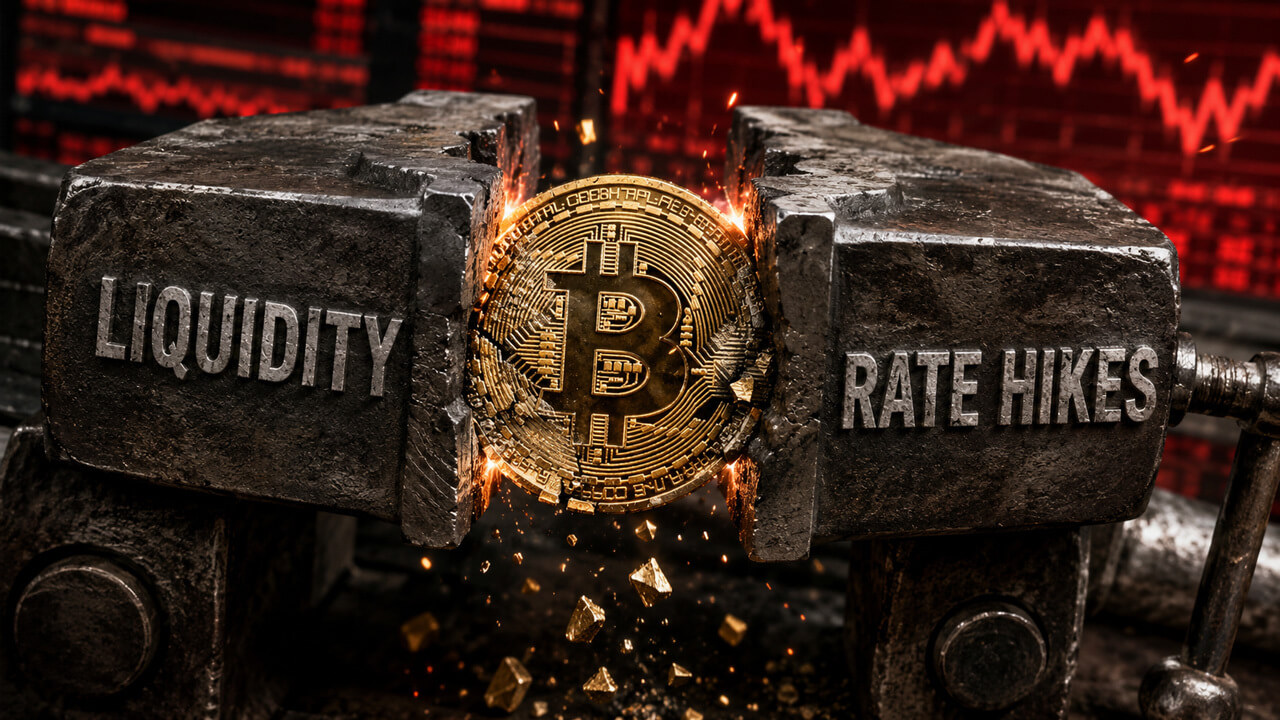
Futures traders went from pricing two or more rate cuts at the start of the year to assigning a 54.1% probability of a rate hike by December, according to CME FedWatch. Only 1.5% odds are given to any easing. That's a full reversal in the expected direction of monetary policy, and for Bitcoin, those two things have very different consequences. When the Fed is expected to cut rates, money gets cheaper, yields fall, the dollar softens, and investors are more willing to hold volatile assets. When the Fed is expected to hike, the opposite happens across all those channels at once.

Bitcoin trades on Fed liquidity before it trades on ideology. The correlation between Bitcoin's price and the Fed's adjusted monetary base has been consistently high since 2020. In an environment of ongoing quantitative tightening (QT), which currently reduces the Fed's balance sheet by $95 billion per month, the liquidity available for risk assets contracts. Additionally, the 10-year Treasury yield hit 4.54% on May 15, a 12-month high, making a non-yielding asset like Bitcoin a harder sell to institutional allocators who compare risk-adjusted returns.
“Bitcoin's price is now almost entirely dependent on the risk appetite and liquidity conditions that Fed policy shapes.”
Coinbase analysts noted that a sustained expansion in Bitcoin's price range would likely require either a clear improvement in systemic liquidity or a definitive downward trend in inflation. The minutes confirmed that neither is visible right now. In fact, the implied probability of a rate hike has surged over 40 percentage points since the start of the year, when it was near zero. This regime shift is not a minor event; it is a complete recalibration of macro expectations that directly impacts Bitcoin's valuation.
On-Chain Data: ETF Flows and Market Signals

- ETF Outflows: The week of May 15, Iranian escalation pushed oil above $110, drove Treasury yields to cycle highs, and triggered nearly $1 billion in Bitcoin ETF outflows, snapping a six-week inflow streak. Outflows were concentrated in Grayscale's GBTC (-$450 million) and BlackRock's IBIT (-$320 million), suggesting both retail and institutional investors are reducing exposure.
- Rate Hike Probability: CME FedWatch shows a 54.1% probability of a rate hike by December 2026, versus only 1.5% odds of a cut. The probability of no change is 44.4%, indicating the market sees a clear upward bias in rates.
- Treasury Yield: The 10-year Treasury yield hit 4.54% on May 15, a 12-month high. The real yield (TIPS) rose to 2.1%, its highest since 2009, increasing the opportunity cost of holding Bitcoin.
- Inflation: April CPI came in at 3.8%, well above the Fed's 2% target. Core CPI, excluding food and energy, was 3.6%, also elevated. Services inflation remains sticky at 5.2%, driven by rising rents and healthcare costs.
- Futures Positioning: Open interest in Bitcoin futures on the CME fell 12% in the week of May 15 to $8.2 billion, while the futures premium over spot narrowed to 3.5% annualized, well below the 10% seen in March. This indicates diminished appetite for long leverage.
Market Impact: The Key Difference Between Delay and Hike
A delayed rate cut and a potential rate hike are easy to conflate, but they describe completely different environments. A delayed cut still means the next major Fed move eventually loosens liquidity. A hike means the opposite: tightening, a stronger dollar, and tighter financial conditions. The U.S. Dollar Index (DXY) has risen 3.2% in May to 105.8, putting downward pressure on dollar-denominated asset prices, including Bitcoin.
The size of the ETF market only exacerbates this dynamic. Before spot Bitcoin ETFs, BTC's macro sensitivity was somewhat buffered by crypto-native infrastructure, where long-term holders (HODLers) maintained positions regardless of the macro environment. But now Bitcoin trades inside the same brokerage accounts as equities and bond funds, and institutional allocators can reduce exposure with the same tools they'd use to trim any other risk position. This has increased Bitcoin's correlation with the Nasdaq 100 to 0.78 year-to-date, up from 0.55 in 2024.
On-chain data also shows a shift in holder behavior. The Coin Days Destroyed (CDD) metric has increased 35% over the past two weeks, indicating that old coins are moving, possibly to exchanges for sale. Active addresses have fallen 8% since early May to 820,000, suggesting a decline in network activity. Meanwhile, Bitcoin's hashrate remains near all-time highs at 650 EH/s, indicating miners are still operating, but miner selling pressure has increased 15% in May, according to data from Poolin.
Your Alpha: Strategies for a Higher-for-Longer Rate Environment
- 1Reduce Bitcoin exposure in rate-sensitive portfolios. The Fed's hawkish pivot suggests macro headwinds will persist. Consider trimming long positions or using options to hedge tail risk. Put options with a strike 20% below the current price (e.g., $60,000 for Bitcoin at $75,000) have relatively low premiums due to current low implied volatility (crypto VIX at 45, down from 60 in March). This could be an efficient hedge.
- 2Monitor Fed minutes and inflation data. The next Fed meeting on June 17 and May CPI (released June 10) will be key catalysts. If inflation doesn't show a clear slowdown, hike odds could rise further. Pay attention to the FOMC statement language: if they remove the reference to "some degree of further tightening" or add an explicit hiking bias, it would be an additional bearish signal.
- 3Look for assets that benefit from a strong dollar. Stablecoins and USD-denominated tokenized real-world assets (RWAs) may have relative outperformance in this environment. For example, tokenized Treasury bonds on platforms like Ondo Finance or Maple Finance offer yields around 4.5%, attracting capital that might otherwise flow to Bitcoin. Additionally, stablecoins like USDC and USDT have seen their combined market cap increase by $5 billion in May to $165 billion, suggesting a rotation from volatile assets into digital safe havens.

Next Catalyst: June FOMC Meeting and Oil Prices
The next Fed meeting in June will be critical. If the FOMC removes the easing-bias language from its statement, as several participants suggested in the April minutes, it would be an additional bearish signal for Bitcoin. Additionally, the market will be watching the updated dot plot, which could show a higher median rate for end-2026. Currently, the March dot plot median pointed to a terminal rate of 3.75%, but with persistent inflation, several members are likely to have revised their projections upward.
Furthermore, the Iranian escalation and its impact on oil prices will remain a key factor. If oil stays above $110, inflationary pressures will persist, keeping the Fed in aggressive mode. Brent crude has already risen 18% in May to $112 per barrel, driven by additional sanctions on Iran and supply disruptions from the Persian Gulf. This could feed a vicious cycle of inflation and monetary tightening.
The Bottom Line

The Fed minutes have confirmed a regime shift: from rate cut expectations to the real possibility of hikes. Bitcoin, trading as a risk asset levered to liquidity, faces significant macro headwinds. Until inflation shows a clear downtrend or the Fed signals a pivot, caution is the prudent stance. Position for a higher-for-longer rate environment, reduce directional risk, and consider assets that benefit from a strong dollar. Patience will be rewarded when the macro cycle eventually turns, but that moment has not yet arrived.