
Rio de Janeiro civil police raided a Comando Vermelho hideout and found 30 mining rigs on shelves, connected directly to a utility pole. The setup had industrial fans and remote monitoring gear. This wasn't just an illegal mining farm — it was a blueprint for a new crypto-crime model.
The gang that controls Rio's favelas is now converting stolen electricity into portable digital value. And that changes the risk landscape for everyone in crypto.
The Signal
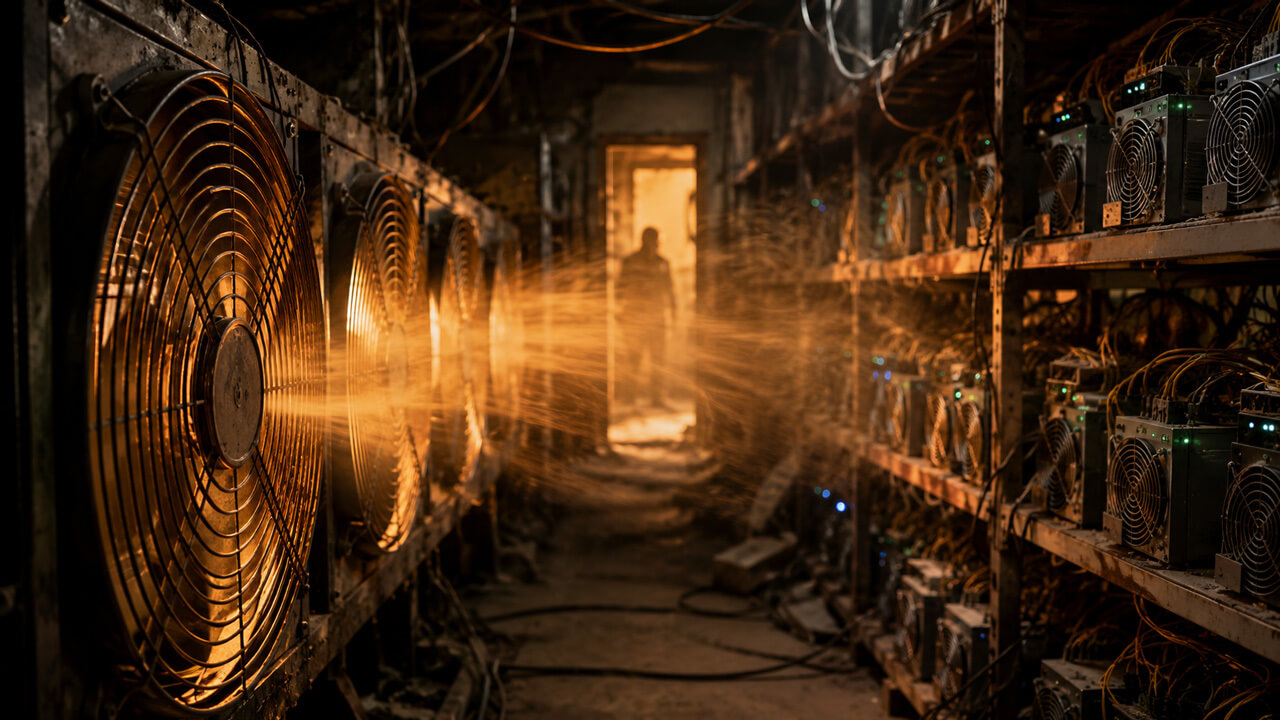
The raid targeted a Comando Vermelho operational nucleus in Complexo do Lins. Police found roughly 30 computers arranged on shelves in an abandoned lot, drawing power from a clandestine electrical connection. The hardware included high-capacity fans and exhaust systems with remote monitoring. This is not an isolated incident: in 2025, federal police dismantled a similar operation in São Paulo, seizing 50 mining rigs illegally connected to the grid. The pattern is consistent: territorial control, stolen electricity, and crypto mining.

The model is straightforward: controlled territory → stolen electricity → mining hardware → portable digital value. Stolen electricity is the load-bearing element. Without it, mining only makes economic sense when power is cheap, subsidized, or free. Cambridge's Bitcoin Electricity Consumption Index identifies electricity as representing 50% to 70% of mining's operating costs. Brazil's electricity regulator ANEEL reported that energy theft cost the country roughly $2 billion in 2024, with Rio de Janeiro among the highest states. To put that in perspective, $2 billion is equivalent to the annual budget of a mid-sized Brazilian city.
At 1.5 kilowatts per machine, 30 computers draw about 45 kilowatts, consuming 32,400 kWh per month. At $0.20 per kWh, that's $6,400 in avoided monthly electricity costs. Unknowns remain — hardware type, coin mined, hash rate, whether crypto was cashed out — but stolen electricity removes the primary variable cost regardless. If the operation had been active for a year, the accumulated savings would be nearly $77,000, enough to purchase more equipment or fund other illicit activities.
“Stolen electricity is the load-bearing element: mining only makes sense when power is cheap, subsidized, or free.”
On-Chain Data

- Monthly savings: $6,400 in avoided electricity costs for a 30-rig setup (32,400 kWh at $0.20/kWh).
- National cost: $2 billion lost to energy theft in Brazil in 2024, per ANEEL.
- Power draw: 45 kW total for 30 rigs, each at 1.5 kW.
- Criminal diversification: Comando Vermelho already runs illegal gold mining and clandestine ride-hailing apps, showing a pattern of monetizing territorial control. The faction is also known to use cryptocurrencies to launder drug trafficking proceeds, according to Federal Police reports.
- Regional trend: In Colombia, armed groups have also ventured into crypto mining with stolen electricity, per a 2025 report by the Financial Information and Analysis Unit (UIAF).
Market Impact
This bust signals a new vector for regulatory risk. If Brazilian authorities link crypto mining to organized crime and energy theft, they could tighten rules on mining pools and exchanges. In fact, in April 2026, the Central Bank of Brazil issued a public consultation on regulating virtual asset service providers, which would include miners. The proposal requires miners to register and report their electricity consumption, making illegal operations harder to sustain.
Legitimate miners already face margin pressure; illegal operations with zero power costs can mine even in bear markets, distorting hash rate distribution. While a legal miner in Brazil pays industrial electricity rates averaging $0.12 per kWh (according to the International Energy Agency), these farms operate at zero energy cost. This could squeeze margins for regulated miners and increase hash rate concentration among illicit actors. In an extreme scenario, if 10% of Bitcoin's hash rate were controlled by illegal operations, the network could be vulnerable to 51% attacks or transaction manipulation.
For the broader market, the Comando Vermelho's move into crypto production could attract more law enforcement attention to on-chain forensics. Companies like Chainalysis may see increased demand for tracing tools. Chainalysis already collaborates with Brazil's Federal Police on crypto money laundering investigations, according to a March 2026 press release. Conversely, if illegal mining output hits exchanges, it could create sell pressure, especially in less liquid altcoins.
Your Alpha
Traders and investors should watch for on-chain signals from Brazilian-linked addresses. Illegal mining proceeds often flow to stablecoins before hitting exchanges. Monitoring sudden spikes in hash rate from Brazilian IPs could flag illicit operations. Historically, when large illegal farms are seized, network hash rate can drop temporarily, affecting mining difficulty and sometimes the asset's price.
- 1Monitor Brazilian mining pools: Look for unexplained hash rate increases from IPs not tied to known miners. Tools like CoinWarz or Blockchain.com can help identify changes in hash rate distribution.
- 2Track stablecoin flows: Illegal mining profits often convert to USDT or USDC. Watch for large transfers to centralized exchanges like Binance, Mercado Bitcoin, or Foxbit. A sudden increase in stablecoin deposits from suspicious addresses could indicate liquidation of illegally mined assets.
- 3Anticipate regulation: Brazil may soon require miners to prove electricity sources, impacting operational costs for legitimate players. If mining with stolen electricity is classified as money laundering, exchanges could demand proof of energy origin from miners. This could affect small miners unable to demonstrate their electricity consumption, potentially reducing hash rate supply and increasing mining fees.
Next Catalyst
Brazil's Federal Police already seized $14 million in criminal assets in May 2026, per Folha. Expect more raids on illegal mining farms, especially in Rio and São Paulo. The government may also accelerate legislation classifying mining as a financial activity, requiring registration and electricity reporting. A bill introduced in March 2026 by Deputy João Carlos proposes that miners obtain a license from ANEEL and undergo periodic energy audits.
Internationally, the case could set a precedent for other countries with energy theft problems, such as Venezuela or South Africa, to implement similar measures. The Financial Action Task Force (FATF) might also update its recommendations to include illegal mining as a money laundering indicator.
The Bottom Line

The Comando Vermelho mining farm is not an anomaly — it's a template. The convergence of organized crime, territorial control, and crypto is creating a new financial crime paradigm. For investors, the risk is both reputational and market-distorting. Stay alert to on-chain signals and Brazilian regulatory moves. The next bust could reshape global mining dynamics.