A researcher won 1 Bitcoin by demonstrating that a quantum computer can break a 15-bit cryptographic key. The achievement is real, but Bitcoin's network remains safe. However, the context has shifted: Google just slashed its resource estimates for breaking 256-bit keys and set a migration deadline of 2029.
The Signal
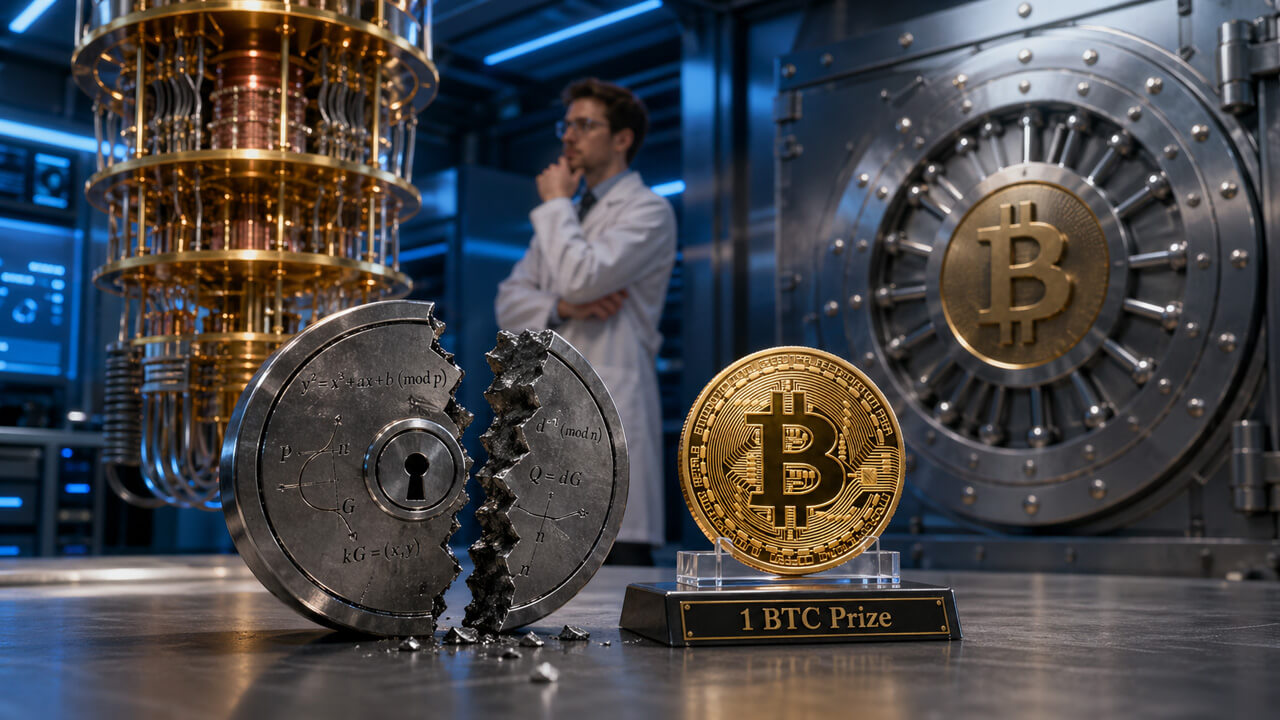

On Apr. 24, Project Eleven awarded its Q-Day Prize to Giancarlo Lelli, who used publicly accessible quantum hardware to derive a 15-bit elliptic curve private key from its public key. This is the largest public demonstration to date of the attack class that could one day threaten Bitcoin, Ethereum, and every other system secured by elliptic curve cryptography. The prize was one Bitcoin. The irony is that a researcher won Bitcoin by breaking a miniature version of the math that protects Bitcoin.
A 15-bit key is nowhere near the security of Bitcoin's 256-bit elliptic curve. No publicly known quantum computer can break real Bitcoin wallets today. The result arrives at a moment when the surrounding context has gotten considerably more serious: Google cut its ECDLP-256 resource estimates and set a 2029 migration deadline in the same month.
“A toy lock was picked using the same family of methods that would one day threaten the vault. The locksmiths improved, and the vault holds for now.”
On-Chain Data
- Key size broken: Lelli derived a private key from a 15-bit public key, with a search space of 32,767 possibilities.
- Jump from prior record: Project Eleven described the result as a 512x jump over Steve Tippeconnic's 6-bit September 2025 demonstration.
- Qubits used: The winning machine had roughly 70 qubits, per Decrypt's reporting.
- Algorithm used: A variant of Shor's algorithm targeting the elliptic-curve discrete logarithm problem (ECDLP), the mathematical foundation of Bitcoin's signature scheme.
- Prize awarded: 1 Bitcoin, paid by Project Eleven.

Market Impact
The crypto market didn't react to the announcement because, in practical terms, there is no immediate threat. However, the impact is more subtle and long-term. Each public demonstration like this reduces skepticism about the viability of quantum computing. For institutional investors evaluating 5-10 year risks, these milestones matter.
Projects already working on post-quantum migrations, such as Ethereum with its roadmap toward quantum-resistant signatures, could see a valuation premium. Conversely, blockchains without a clear plan may face risk discounts in the future. The clock is ticking: Google set 2029 as a deadline.
Your Alpha

- 1Don't panic: Bitcoin's security is not compromised. The 15-bit demonstration is 241 orders of magnitude away from real 256-bit security. There is no reason to sell out of quantum fear.
- 2Monitor post-quantum projects: Blockchains like Ethereum, Cardano, and Algorand that are actively researching quantum-resistant signatures could benefit from growing attention. Look for protocol upgrades and improvement proposals.
- 3Watch Google: The company published new ECDLP-256 resource estimates on Mar. 31. If they cut estimates again, the market will react. Follow their technical publications.

Next Catalyst
The next major milestone will be the next edition of the Q-Day Prize, which will likely demand breaking larger keys. If the record jumps from 15 bits to 20 or 25 bits, the conversation will intensify. Additionally, Google may update its resource estimates before year-end, which would be a market-moving event if they show a significant reduction.
Also watch Ethereum upgrades: the network has a plan to implement quantum-resistant signatures in the coming years. Any concrete progress on that front could revalue ETH relative to competitors without a clear roadmap.
The Bottom Line
Lelli's demonstration is a technical milestone, not a threat. Bitcoin and Ethereum are safe today, but the timeline for migrating to post-quantum cryptography is shortening. Google set 2029 as a deadline. Investors should educate themselves, not panic. The next time you see a headline about quantum computing breaking Bitcoin, remember: the toy lock was picked, but the vault remains closed.
Deeper Analysis: The Security Gap in Perspective
To understand why a 15-bit key is no threat, compare search spaces. A 15-bit key has 2^15 = 32,768 possibilities. A 256-bit key has 2^256 possibilities, an astronomically larger number. The difference is exponential. Breaking a 15-bit key with a 70-qubit quantum computer is like finding a needle in a room-sized haystack. Breaking a 256-bit key would require a haystack the size of the observable universe.
Moreover, Shor's algorithm, while theoretically efficient for factoring and discrete log, requires a number of logical qubits that is still far from reach. Google's estimates suggest roughly 20 million physical qubits (with error correction) are needed to break a 256-bit key in 24 hours. Today's most advanced systems have a few hundred physical qubits, and error correction is still nascent.
Google's Timeline: Industry Implications
On March 31, 2026, Google published updated estimates reducing the resources needed for ECDLP-256 by a factor of 10 from prior estimates. Additionally, the company set a migration deadline of 2029, urging the industry to adopt post-quantum cryptography by then. This timeline is aggressive but realistic, putting pressure on blockchain developers to start planning the transition.
For Bitcoin, migration would involve a signature change (e.g., to Lamport or Winternitz schemes) requiring a soft or hard fork. The Bitcoin community has discussed this but lacks a concrete plan. Ethereum, on the other hand, has already included quantum resistance in its post-merge roadmap, with EIP-7560 introducing hash-based signatures. This could give it a long-term competitive edge.
Market Sentiment Shift
Although Bitcoin's price did not move on the announcement, institutional investor sentiment may be subtly shifting. According to a 2025 Fidelity survey, 42% of institutional investors considered quantum risk a relevant concern for their crypto holdings over a 10-year horizon. Each public demonstration like Lelli's reinforces that concern and accelerates demand for post-quantum solutions.
In the derivatives market, no increase in implied volatility or put option volume was observed, suggesting traders see no imminent threat. However, if Google publishes another estimate reduction before year-end, we could see a repricing of quantum risk in the markets.
Conclusion: Prepare, Don't Panic
Lelli's demonstration is a reminder that quantum computing is advancing faster than many expected. But it also shows we are still far from a real threat. The right approach for investors is to monitor developments, support projects working on solutions, and avoid rash decisions based on alarmist headlines. The window for migration is closing, but there is still time.