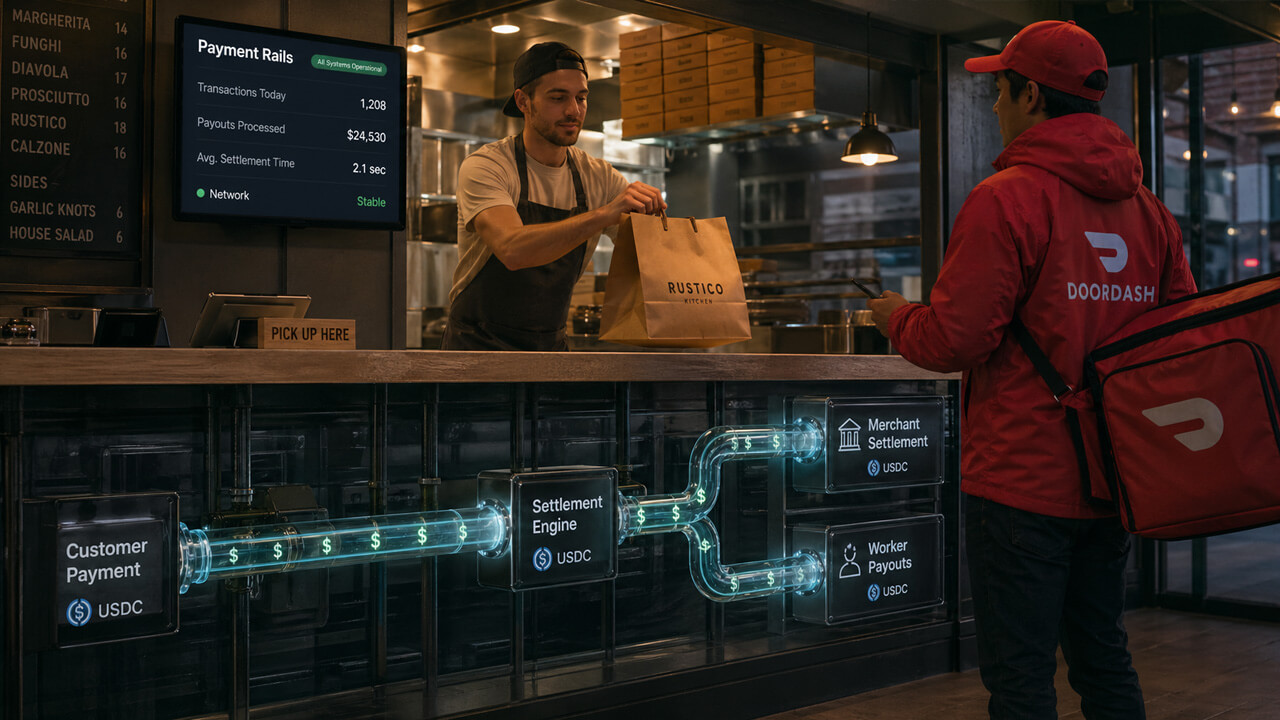
DoorDash Payouts Go Stablecoin: Shift in 40+ Countries
DoorDash integrates stablecoin payouts across 40+ countries via Stripe-backed Tempo. Settlement delays drop from days to seconds. A blueprint for gig economy ra
Stablecoins are moving from speculative asset to settlement layer for internet-native commerce.
This isn't a pilot or a press release about "exploring blockchain." It's production code moving real money to merchants and delivery drivers...
The decision stems not from a theoretical interest in cryptoassets, but from a concrete operational need: reducing friction in cross-border ...
DoorDash just plugged stablecoins into its core payment infrastructure across 40+ countries.
This isn't a pilot or a press release about "exploring blockchain." It's production code moving real money to merchants and delivery drivers. The company, which processes millions of transactions daily, has decided to adopt the Tempo network — a payments-focused blockchain backed by Stripe and Paradigm — to route payouts to Dashers and settlements to merchants. This move, though understated, represents a seismic shift in how gig economy platforms manage their international cash flows.
The decision stems not from a theoretical interest in cryptoassets, but from a concrete operational need: reducing friction in cross-border payments. In a world where customers expect instant gratification, traditional settlement processes can take hours or even days, depending on the country, bank, and payment method. For a company operating in over 40 jurisdictions, each with its own currency, regulations, and banking system, that delay translates into enormous hidden costs. Merchants feel it in working capital — slower settlement affects payroll, inventory, and short-term liquidity. Dashers feel it in immediate cash availability, especially during periods of rising fuel or living costs. DoorDash itself addressed that pressure last month with gas relief measures for US and Canadian Dashers.
DoorDash logistics hub with delivery drivers
The Signal
The Signal
DoorDash is working with Tempo — the payments-focused blockchain built by Stripe and Paradigm — to route payouts to Dashers and settlements to merchants. Tempo launched in 2025 with high throughput, sub-second finality, and stablecoin-native fees. Its partner list already includes Deutsche Bank, Shopify, OpenAI, Revolut, and Visa. DoorDash co-founder Andy Fang said the appeal is "making payouts faster and more affordable." For a company handling millions of transactions daily, the bottleneck isn't the customer order — that's instant. The bottleneck is the backend: settlements that can stretch from hours to days depending on jurisdiction, banking partners, and payment rails.
That friction creates hidden costs at scale. Merchants feel it in working capital — slower settlement affects payroll, inventory, and short-term liquidity. Dashers feel it in immediate cash availability, especially during periods of rising fuel or living costs. DoorDash itself addressed that pressure last month with gas relief measures for US and Canadian Dashers. The Tempo integration attacks this problem directly: by settling in stablecoins, funds become available in seconds, eliminating the need for banking intermediaries and reducing currency conversion costs. For Dashers in countries with volatile currencies, receiving payments in USDC or USDT also offers a natural hedge against inflation.
“Stablecoins are moving from speculative asset to settlement layer for internet-native commerce.”
On-Chain Data
Tempo Network: Built by Stripe and Paradigm, designed for high throughput, sub-second finality, and stablecoin-native fees.
Key Partners: Deutsche Bank, Shopify, OpenAI, Revolut, Visa, and now DoorDash.
Coverage: DoorDash operates in 40+ countries, each with different currencies, regulations, and banking systems.
Settlement Speed: From days to seconds for cross-border payments, removing banking intermediaries.
Transaction Volume: Millions of daily transactions between customers, merchants, and Dashers.
Tempo transaction dashboard
Market Impact
Market Impact
This move changes the stablecoin narrative. Until now, the market viewed them as trading tools or safe havens during volatility. But the real use case — payment settlement — is where mass adoption can happen. For the crypto ecosystem, the signal is clear: large platforms don't need to be convinced about the technology; they need efficiency. Stripe has been publishing detailed explainers on stablecoin payments, payout strategies, and growth drivers. The pattern is consistent: businesses adopt stablecoins when they reduce delays, lower costs, expand geographic reach, and improve cash flow predictability.
The immediate impact will be on stablecoin demand — USDC and USDT could see increased transfer volumes from non-speculative sources. Infrastructure projects like Tempo — or competitors like Solana Pay — benefit from the validation that a company like DoorDash provides. In market terms, this move could also pressure traditional payment networks (Visa, Mastercard) to accelerate their own blockchain-based solutions, though they are already partners with Tempo. The competition for the global commerce settlement layer is intensifying.
Your Alpha
1Follow infrastructure, not tokens. The DoorDash integration shows value is in payment networks, not the coins themselves. Look for blockchains optimized for payments: high speed, low fees, fast finality. Projects like Solana, Polygon, or Ethereum L2s could benefit if they position themselves as settlement layers for enterprises.
2Watch general-purpose stablecoins. USDC and USDT are the most used for enterprise payments. Any similar announcement from other platforms (Uber, Rappi, Glovo) could spike their transfer volumes. Also, pay attention to regulated stablecoins like USDC, which meet transparency and reserve standards, making them more attractive for compliance-conscious businesses.
3Don't ignore regulation. Cross-border stablecoin payments require AML/KYC compliance in every jurisdiction. Companies that solve this first will have a competitive edge. Regulatory clarity in the EU (MiCA) and other markets will be a key catalyst for mass adoption.
trader analyzing stablecoin charts
Next Catalyst
Next Catalyst
The logical next step is for other delivery and gig economy platforms to follow DoorDash. Uber has already experimented with crypto for driver payments. Rappi and Glovo in Latin America are natural candidates, given the region's high stablecoin usage for remittances and savings. Moreover, Tempo's integration with Stripe — which processes payments for millions of merchants — opens the door for any Stripe business to offer stablecoin payouts without changing providers. If Stripe enables this by default, the impact could be massive.
Another potential catalyst is Tempo's expansion to more blockchains or interoperability with other networks. If Tempo becomes a multi-chain settlement hub, it could capture even more volume. Also, monitor central bank reactions: some may see this as a threat to monetary control, while others may collaborate to issue CBDCs that compete with private stablecoins.
The Bottom Line
DoorDash isn't running a crypto experiment. It's solving a real operational problem: the slowness and cost of international payments. Stablecoins are the tool, not the end goal. For investors, the lesson is clear: the next wave of adoption won't come from speculators, but from companies that need money to move faster. And that's exactly what's happening.
The stablecoin payment market is just getting started. Those who understand this today will be positioned for the cycle ahead. The DoorDash integration is a signal that stablecoins are moving from a speculative niche to critical financial infrastructure. Investors who focus on real-world use cases, rather than market noise, will be the ones to capture long-term value.