
A German newspaper delivery teen earned 10 German marks per hour in the 1980s, enough for 33 scoops of ice cream. By 2025, that same hour of work yields at most €12, buying just 8 scoops. That is an 80% loss in real purchasing power—and a stark lesson in how inflation silently erodes wages and savings alike.
The Signal
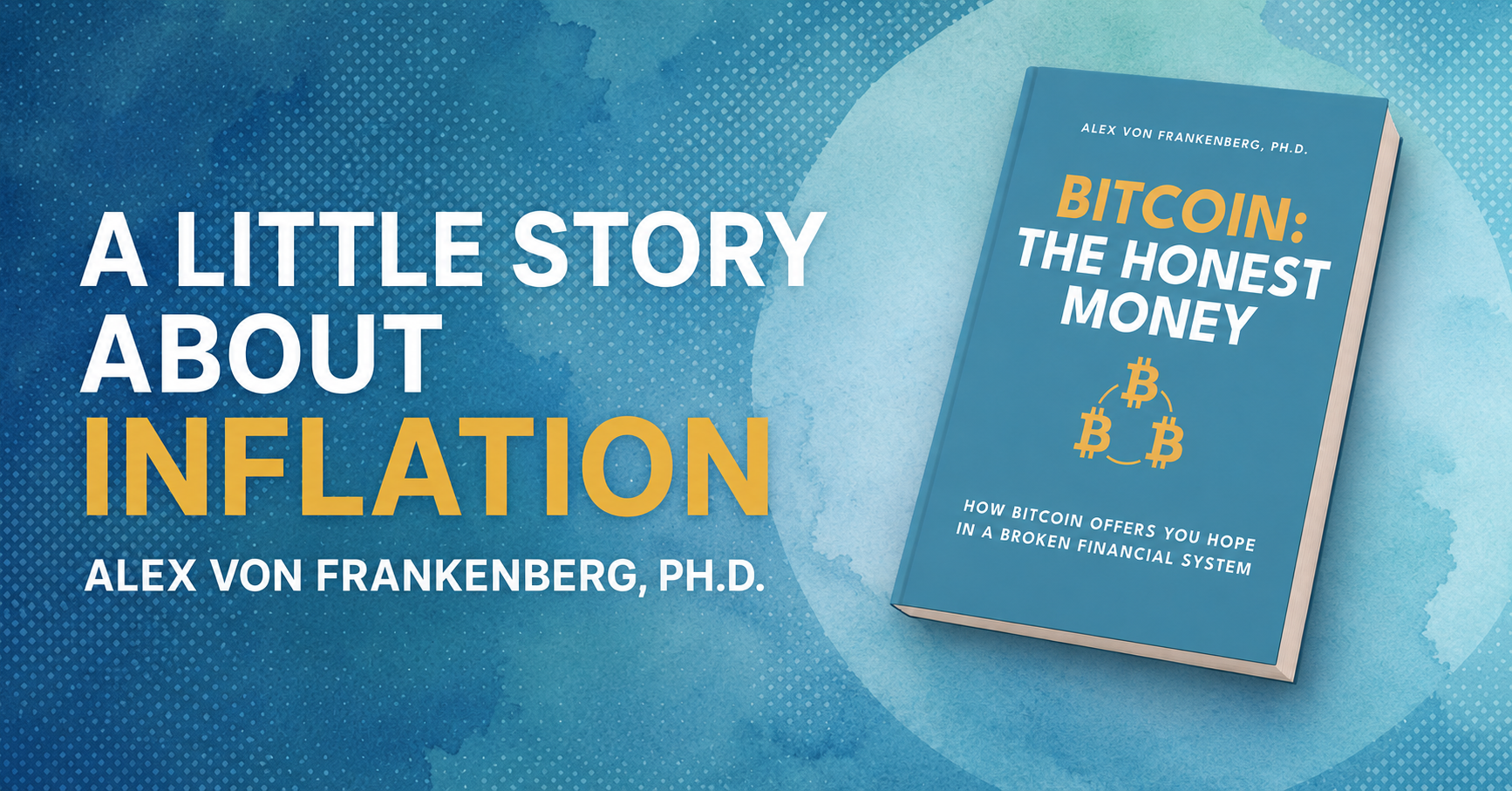
Alex von Frankenberg's excerpt from *Bitcoin: The Honest Money* uses a simple ice cream analogy to illustrate a brutal reality: inflation doesn't just devalue cash in a drawer; it devalues the time you spend earning that cash. Over forty years, a German paperboy's hourly wage lost 80% of its ice cream purchasing power. If he had stashed his 10 marks under a mattress, they'd now buy just 2 to 3 scoops—a 93% loss.

The global M2 money supply is estimated at $120 trillion. Even at a conservative 4% inflation rate, that means $4.8 trillion in purchasing power is destroyed every year—more than Germany's entire GDP. Frankenberg estimates that 90% of citizens have no way to protect themselves from this silent wealth transfer. Inflation, he argues, has historically preceded revolutions and the collapse of empires, from Rome to revolutionary France.
“"$4.8 trillion in purchasing power is destroyed each year by inflation—more than Germany's entire GDP."”
To put this in perspective, consider the U.S. dollar: since the end of the Bretton Woods system in 1971, the dollar has lost over 85% of its purchasing power. In countries like Venezuela or Zimbabwe, hyperinflation has wiped out savings entirely. The paperboy's story is a microcosm of a global phenomenon. The M2 money supply in the U.S. alone has grown from $1.5 trillion in 1980 to over $21 trillion in 2026, a 14-fold increase. Meanwhile, the supply of Bitcoin is capped at 21 million, with over 19.9 million already mined. This fixed supply makes Bitcoin a natural hedge against the relentless expansion of fiat money.
On-Chain Data

- Bitcoin's Fixed Supply: Only 21 million BTC will ever exist. As of early 2026, 19.9 million (95%) have already been mined. The remaining 5% will be issued over the next ~115 years.
- No Inflation Mechanism: Bitcoin's issuance schedule is immutable. No central bank can print more. Once all 21 million are mined around 2140, the supply becomes perfectly inelastic.
- Global M2: $120 trillion. Annual destruction at 4% inflation: $4.8 trillion. Bitcoin's market cap (~$1 trillion) is a fraction of that annual loss.
- Real Wage Decline: German newspaper delivery: 33 scoops/hour in 1980s → 8 scoops/hour in 2025. An 80% loss in real terms.
- Network Hashrate: Exceeds 600 EH/s, indicating a secure and decentralized network. Mining difficulty adjusts every 2,016 blocks to maintain a consistent block time, regardless of demand.

These on-chain metrics reinforce Bitcoin's status as hard money. While M2 grows at 4-10% annually depending on the country, Bitcoin's supply grows at less than 2% per year and is heading toward zero. The blockchain allows anyone to verify the supply in real time, eliminating the opacity of central bank money. Moreover, the number of addresses holding at least 0.1 BTC has surpassed 4 million, indicating a broadening user base. The average transaction value has also increased, suggesting that larger entities are moving into the space.
Market Impact
Bitcoin positions itself as the antidote to this systemic devaluation. While fiat currencies lose purchasing power year after year, Bitcoin's supply is fixed and its monetary policy is transparent. For institutional investors and retail savers alike, this is a powerful value proposition. It's not just about price speculation; it's about preserving the value of labor and savings over decades.
The current macroeconomic environment—persistent inflation, geopolitical uncertainty, and declining trust in central banks—amplifies Bitcoin's appeal. The historical link between inflation and social upheaval adds urgency. Bitcoin offers a decentralized, censorship-resistant alternative that doesn't rely on any government's promise.
In 2026, Bitcoin's correlation with traditional risk assets like tech stocks has declined, suggesting it is maturing as an independent store of value. Spot Bitcoin ETFs in the U.S. have seen net inflows exceeding $15 billion year-to-date, with positive flows even on down days. This indicates that institutional investors are buying the inflation-hedge narrative. Companies like MicroStrategy and Tesla continue to hold their Bitcoin, and new firms are adding it to their treasuries. The Chicago Mercantile Exchange (CME) has also seen record open interest in Bitcoin futures, further validating institutional demand.
Your Alpha

For investors, the takeaway is clear: cash and bonds are losing purchasing power in real terms. Bitcoin, despite short-term volatility, offers a store of value that cannot be diluted. Those who understand this dynamic can position themselves to protect their wealth over the long term.
- 1Strategic Allocation: Allocate 1-5% of your portfolio to Bitcoin as a long-term inflation hedge. Focus on a 5-10 year horizon to ride out volatility. Portfolio simulations show that a 2% allocation to Bitcoin improves risk-adjusted returns without significantly increasing overall volatility.
- 2Systematic DCA: Dollar-cost average into Bitcoin weekly or monthly. The decreasing issuance rate favors early accumulators. For example, investing $100 weekly in Bitcoin since January 2020 would have turned $33,600 into over $150,000 by early 2026, despite several 50% drawdowns along the way.
- 3Self-Custody: Hold your own keys using a hardware wallet. Financial sovereignty begins with control over your private keys. Consider using multiple wallets and storing seed phrases in secure, offline locations. Never share your seed phrase with anyone.
An additional tip: only invest what you can afford to lose. Bitcoin is volatile and can drop 50% or more at any time. However, its long-term trend has been upward due to its scarcity and growing adoption. Patience and discipline are key.
Next Catalyst
As 2026 progresses, Bitcoin's issuance rate continues to decline. Each new block yields fewer coins, while institutional demand grows via spot ETFs and corporate treasuries. The approaching 2140 halving endpoint keeps the scarcity narrative alive.
On the macro front, central banks struggle to contain inflation. If real interest rates remain negative, Bitcoin's role as hard money strengthens. Key upcoming events include US inflation data releases and Federal Reserve meetings, which could trigger significant price movements. Additionally, potential adoption announcements from sovereign wealth funds or large corporations, as well as regulatory developments in the EU and Asia, could act as catalysts. The approval of Bitcoin ETFs in markets like Hong Kong or London would open new demand channels.
The Bottom Line

Inflation is not an abstract statistic—it's the reason your grandparents could buy a house on one salary while you struggle to afford rent. Bitcoin offers a way out: a monetary network with a fixed supply that cannot be debased. In a world awash with $120 trillion in M2, owning a piece of the 21 million Bitcoin cap is a rational hedge. The ice cream is melting, but Bitcoin is frozen in time.