Bitcoin Art: The $25,200 Plein Air Protest That Predicted Crypto's Ris
Alex Schaefer's 'Banks on Fire' series sold for $25,200 in 2011, connecting street art to Bitcoin's Genesis Block message about bank bailouts and the financial
A painter faced police questioning for painting banks on fire outside their branches. His art captured the post-2008 anger that fueled Bitcoin's revolution, creating a tangible bridge between street protest and the digital transformation that would redefine global finance.
In the summer of 2011, as Bitcoin turned two years old and traded around $30, Alex Schaefer set up an easel across from a Chase Bank branch ...
The Bitcoin connection is direct and textual. Bitcoin's Genesis Block, mined January 3, 2009, includes The Times headline: "Chancellor on br...
A painter faced police questioning for painting banks on fire outside their branches. His art captured the post-2008 anger that fueled Bitcoin's revolution, creating a tangible bridge between street protest and the digital transformation that would redefine global finance.
The Signal
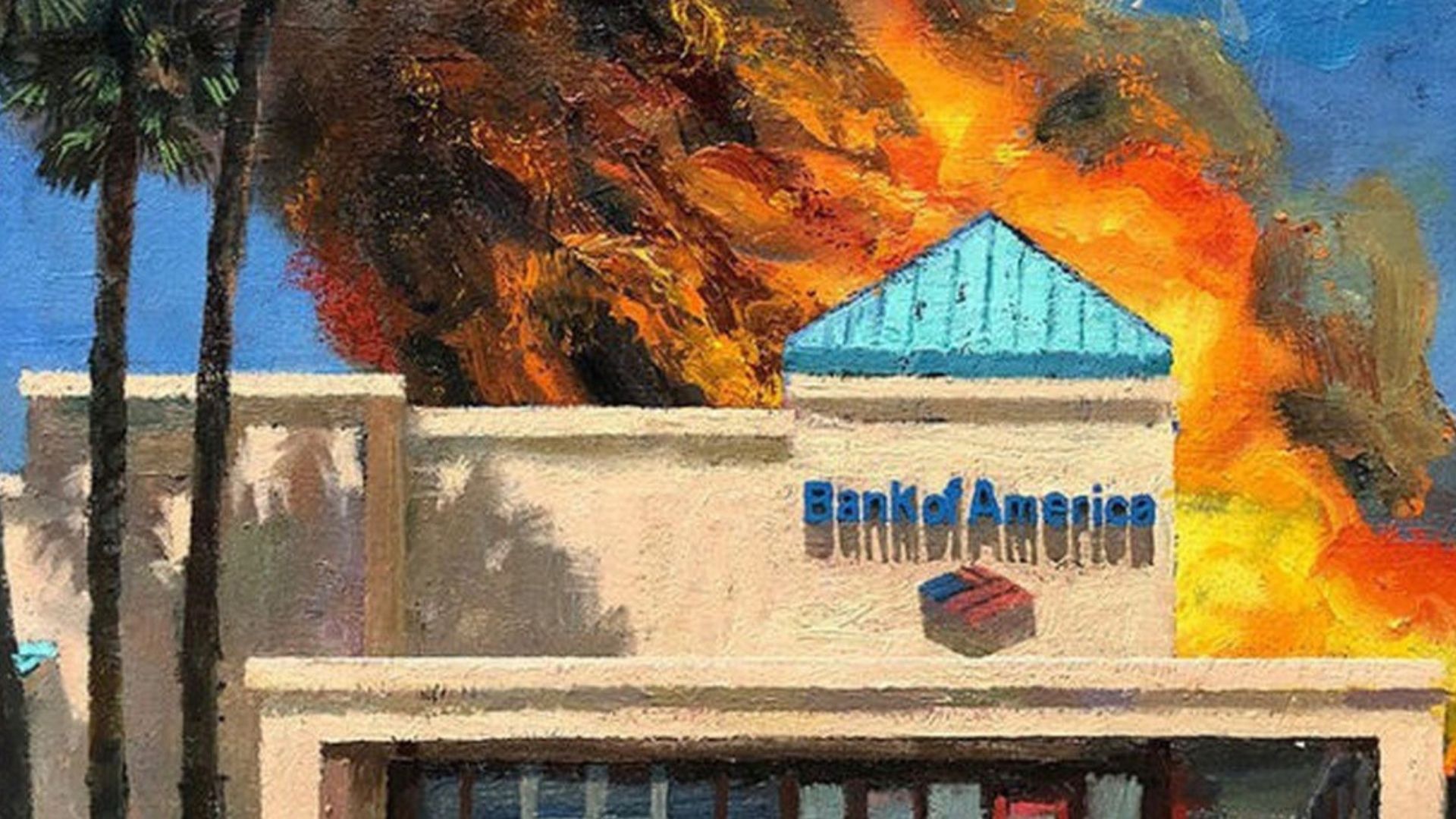
In the summer of 2011, as Bitcoin turned two years old and traded around $30, Alex Schaefer set up an easel across from a Chase Bank branch in Van Nuys, California. He didn't paint the building as it stood, but rather engulfed in flames, with black smoke rising above palm trees. This scene unfolded three years after the 2008 bank bailouts, when trust in traditional financial institutions had cratered. The Occupy Wall Street movement was spreading nationwide, and the sentiment that "the money is bullshit" resonated with those who saw the system as corrupt. Schaefer, trained at the prestigious ArtCenter College of Design in Pasadena, had spent eight years as a digital artist before returning to traditional painting—a pivot reflecting his desire to create physical protest in an increasingly digital world.
The Bitcoin connection is direct and textual. Bitcoin's Genesis Block, mined January 3, 2009, includes The Times headline: "Chancellor on brink of second bailout for banks." Schaefer began his 'Banks on Fire' series that same year, working en plein air in front of the institutions Satoshi Nakamoto sought to replace. While Bitcoin operated as a technical experiment on cryptography forums, Schaefer brought financial system critique to the streets, facing police questioning and arrests for his art. In July 2012, he spent twelve hours in jail for chalking "Crooks" next to Chase's logo, an incident underscoring the tension between artistic expression and institutional control.
easel facing burning bank building
The temporal parallel between 'Banks on Fire' launching in 2009 and Bitcoin's release that same year isn't coincidental. Both emerged from the same post-2008 distrust cauldron, where the $700 billion U.S. bank bailout had exposed systemic failures of financial capitalism. Schaefer worked in Southern California, epicenter of the mortgage crisis, while Satoshi operated from digital anonymity. Street protest art and Bitcoin's code shared the same diagnosis: the financial system was broken and needed radical alternatives. Schaefer visually documented what Bitcoin proposed to solve technically, creating a visual narrative that anticipated the crypto revolution.
On-Chain Data
On-Chain Data
eBay sale 2011: $25,200 for the first 'Banks on Fire' painting to a German collector, establishing early precedent for financial protest art value
Digital art years: 8 years as a digital artist before returning to traditional painting, reflecting evolution from digital to physical that contrasts with crypto art's reverse trajectory
2012 arrest: 12 hours in jail for misdemeanor vandalism with chalk, demonstrating institutional resistance to public financial criticism
Series start: 2009, same year as Bitcoin's Genesis Block, creating historical parallel between artistic protest and technological revolution
Formal training: ArtCenter College of Design in Pasadena, one of America's top art schools, contrasting with many crypto pioneers' self-taught backgrounds
Bitcoin price context: In 2011, when Schaefer painted outside Chase, Bitcoin traded around $30, a tiny fraction of its future value, underscoring how early his artistic intervention was
Bitcoin transaction visualization 2009-2011
On-chain analysis of Bitcoin during 2009-2011 reveals a nascent but growing ecosystem. In 2009, transactions were sporadic, mainly among technical enthusiasts. By 2011, when Schaefer sold his painting for $25,200, Bitcoin had surpassed dollar parity and began attracting broader attention. Schaefer's sale equaled approximately 840 BTC at then-prices, an amount that would represent tens of millions today. This numerical convergence underscores how financial protest art's narrative value and Bitcoin's technological value emerged simultaneously from the same systemic crisis.
Market Impact
The exhibition of 'Banks on Fire' at Bitcoin 2026 isn't coincidental curation but institutional recognition that financial protest art and digital assets share deep ideological roots. For NFT and crypto art collectors, Schaefer's works represent physical artifacts from the pre-Bitcoin era that validate decentralization narratives. Their market value ($25,200 in 2011) sets historical precedent for how art critiquing traditional finance can appreciate within crypto ecosystems, creating a valuation bridge between previously separate worlds.
Blockchain art projects exploring financial dissent themes—protest NFTs, generative art with anti-centralization messages—benefit directly from this historical lineage. Platforms like SuperRare, Foundation, and Nifty Gateway can contextualize contemporary works within this tradition, adding narrative depth that transcends momentary speculation. For crypto art investors, understanding this historical connection helps assess which works have long-term appreciation potential beyond volatile market trends. Art documenting the 2008 crisis and its aftermath represents an emerging category with solid narrative foundations, similar to how Great Depression art gained historical value decades later.
The traditional art market has begun recognizing this cross-over value. Auction houses like Christie's and Sotheby's, which now regularly sell NFTs, are curating exhibitions connecting historical protest art with contemporary crypto works. This convergence creates new valuation metrics where historical authenticity and narrative relevance become factors as important as artistic technique. For traditional artists working financial themes, the crypto ecosystem offers a new market willing to value their systemic critique, creating economic opportunities that didn't exist in traditional gallery circuits.
Your Alpha
Your Alpha
Art documenting financial dissent is gaining narrative value in crypto ecosystems, creating strategic opportunities for collectors, artists, and platforms. Collectors seek works connecting to Bitcoin's ideological origins, validating decentralization narratives with tangible historical artifacts.
1Identify traditional artists whose work critiques financial systems and explore NFT tokenization or collaboration opportunities. Look for artists who worked during the 2008 crisis or its immediate aftermath, particularly those with exposure to protests like Occupy Wall Street. Platforms like Verisart can authenticate physical works for NFT conversion, creating digital assets with verified provenance.
2Consider financial protest art as a distinct collection category within your crypto art portfolio. Allocate a specific percentage (5-15%) to works documenting historical financial crises or critiquing banking centralization. This category offers narrative diversification and appreciation potential as the crypto ecosystem matures and seeks historical validation.
3Monitor exhibitions and events connecting traditional art with crypto narratives to identify emerging curatorial trends. Bitcoin 2026 and similar conferences are developing artistic programs tracing historical lines. Institutions including financial protest art in their crypto exhibitions signal which narratives are gaining institutional legitimacy.
NFT art trading dashboard
Next Catalyst
Bitcoin 2026, where Schaefer is paneling, will serve as a critical platform connecting more traditional artists with crypto ecosystems. Organizers are curating exhibitions tracing direct lines between financial protest art and Bitcoin philosophy, creating new valuation contexts for works that previously existed mainly in traditional galleries. This event represents an institutional inflection point where financial critique art gains legitimacy within the crypto mainstream.
2026 crypto art auctions will likely include more works with decentralization and financial critique themes, with price benchmarks set by sales like Schaefer's 2011 $25,200 transaction. Institutional collectors entering crypto seek historical artifacts validating Bitcoin's narrative, creating demand for works predating crypto but anticipating its principles. This phenomenon resembles how 1960s countercultural art gained value decades later when its visions became normalized.
The parallel development is tokenization of historical financial protest art. Platforms are digitizing art from movements like Occupy Wall Street, Black Lives Matter (in its economic dimension), and anti-austerity protests. These tokenized works offer crypto collectors exposure to dissent narratives with historical authenticity, creating a secondary market for art that previously had limited circulation. By 2026, this segment is expected to represent 10-20% of the high-end crypto art market.
The Bottom Line
The Bottom Line
Alex Schaefer's art demonstrates that the financial system critique fueling Bitcoin's creation existed in tangible forms before the first cryptocurrency. His 'Banks on Fire' series, selling for $25,200 in 2011, represents a historical bridge between street protest and digital revolution, offering crypto market participants physical artifacts of the dissent that inspired this movement. The convergence of his work with Bitcoin 2026 signals crypto ecosystem maturation, now seeking historical validation and narrative depth beyond technological speculation.
To position strategically in crypto art markets, participants should seek works connecting historical narratives with the decentralization principles driving digital asset adoption. Art documenting past financial crises offers not just aesthetic value but ideological validation for the broader crypto project. As the ecosystem evolves from technical experiment to cultural movement, these historical artifacts will gain importance as narrative cornerstones, creating opportunities for artists, collectors, and platforms that understand this intersection of art, protest, and financial technology.