
Stake DAO promised to simplify yield farming: deposit CRV, receive sdTokens, and forget the rest. On May 26, 2026, an attacker minted 5.4 trillion vsdCRV on Arbitrum, revealing that automation only hides risks—it doesn't eliminate them.
The Signal
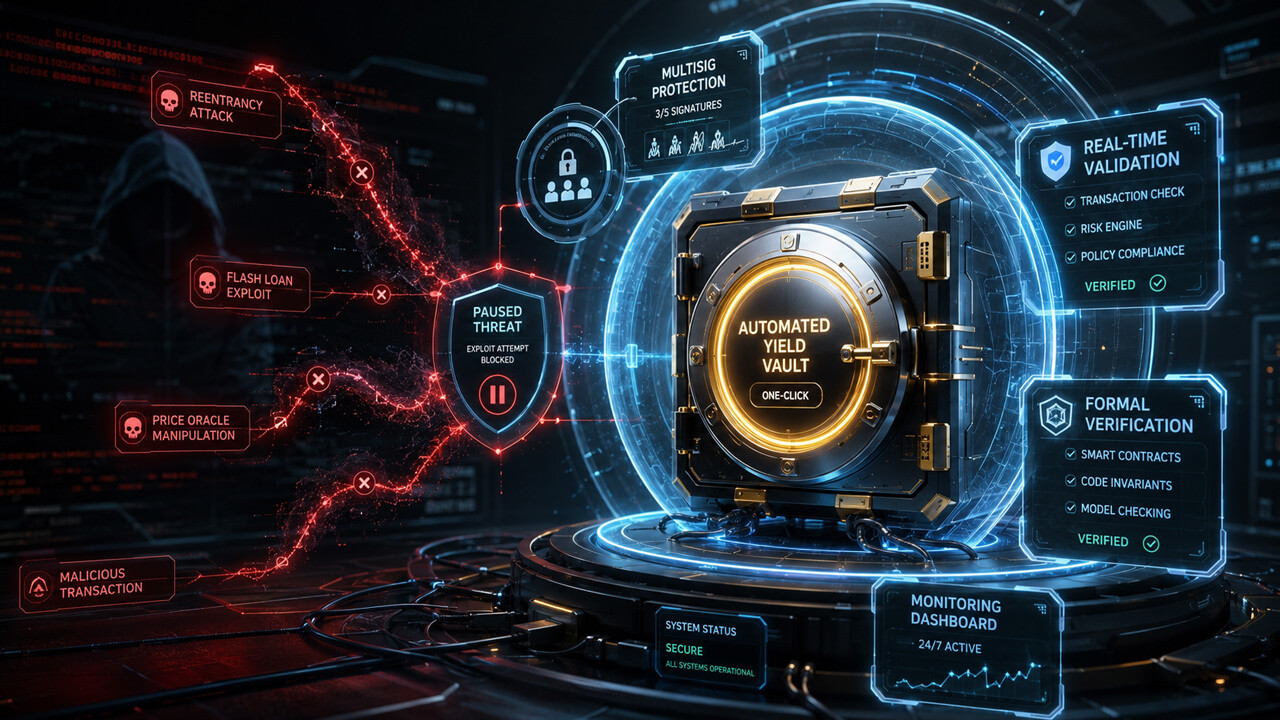
Automated yield protocols were DeFi's most persuasive retail pitch: deposit into a vault, and the protocol handles everything else. For users wanting Curve's boosted yields without managing CRV locks, vote power, wrappers, gauges, and incentives, Stake DAO packaged the full stack behind a simple interface. In doing so, it also packaged what could break. According to Blockaid, an attacker compromised a deployer key, altered LayerZero peer configuration to forge a cross-chain message, and minted 5,446,744,073,709 vsdCRV. They converted a portion into roughly 43.78 ETH, though liquidity constrained realized extraction far below the nominal mint.

The incident spread like wildfire: Curve warned users about an affected LlamaLend market on Arbitrum, and Beefy Finance paused a connected vault exposed to Curve and Convex. Stake DAO told users not to interact with vsdCRV while the situation was active. The vault interface hides everything—deployer keys, cross-chain messaging trust, wrapper-token accounting, and oracle dependencies—making the complexity invisible until something breaks. Automated yield moves DeFi complexity out of sight, a relocation that only becomes visible when the hidden layer fails.
“The 5.4 trillion vsdCRV exploit proves that simplicity in DeFi is an illusion: every hidden layer is a potential point of failure.”
On-Chain Data

- Minted amount: 5,446,744,073,709 vsdCRV, a figure exceeding the total supply of many protocols.
- Realized extraction: Only ~43.78 ETH converted, limited by pool liquidity.
- Monthly context: April 2026 was DeFi's worst exploit month, with ~$635 million lost across 28 incidents.
- Attack vector: Deployer key compromise and LayerZero configuration manipulation to forge cross-chain messages.
- Affected protocols: Stake DAO, Curve (LlamaLend on Arbitrum), and Beefy Finance (paused vault).

Market Impact
The attack didn't just hit Stake DAO; it revealed a systemic vulnerability in automated vaults. These products, designed to attract retail capital, now become contagion vectors. When a vault pauses, liquid tokens (sdTokens) lose peg, lending markets destabilize, and integrated protocols suffer domino effects. Curve and Beefy already felt the impact.
For investors, the cost isn't just the direct exploit. The risk premium on automated vaults will rise: users will demand higher returns for bearing hidden risks. This could reduce TVL in these products and favor more transparent or self-custody strategies. Manuel Aráoz, co-founder of OpenZeppelin, declared he considers "all" of DeFi unsafe due to "superhuman" AI agents finding vulnerabilities. OpenZeppelin publicly rejected the claim, but the debate is now center stage.
Your Alpha

- 1Audit hidden risks: Before depositing in an automated vault, investigate dependencies: does it use oracles? cross-chain messaging? deployer keys? Each layer is a potential failure point.
- 2Prioritize real-time security: Blockaid and other transaction validation tools before execution are the new frontier. Look for protocols integrating them.
- 3Diversify strategies: Don't concentrate all capital in automated vaults. Combine with manual or lower-complexity strategies to mitigate systemic risks.

Next Catalyst
The market expects regulators to take notice. The SEC is already investigating DeFi protocols for lack of transparency, and an exploit of this magnitude could accelerate action. Additionally, the post-exploit security patch season often creates volatility in affected tokens (CRV, SDT).
Development teams are under pressure to implement robust governance controls and real-time monitoring tools. The question is whether they'll do it before the next attack. As Blockaid's Ido Ben-Natan noted: "Wherever there is value on-chain, there will be attackers." Automation is not an excuse for security.
The Bottom Line
The Stake DAO exploit is not an isolated incident; it's a warning that abstraction in DeFi has a price. Automated vaults offer convenience but hide layers of risk that investors must understand. Next time you deposit in a vault, ask yourself: what am I really delegating? The answer may be more than you think. Position yourself in protocols with transparency and real-time security; the era of blind trust is over.
Deeper Analysis: Implications for the DeFi Ecosystem
The Stake DAO exploit extends beyond the directly affected protocols, carrying broader implications for the DeFi ecosystem. First, it highlights the fragility of cross-chain dependencies. LayerZero, used for inter-chain messaging, has become a critical attack vector. Developers must reconsider the trust placed in such bridges and consider additional verification mechanisms, such as fraud proofs or decentralized validation.
Second, the incident underscores the need for better investor education. Many users deposit funds into automated vaults without fully understanding the underlying risks. Protocols should provide clearer risk disclosures and simulation tools that allow users to assess the potential impact of an exploit. Additionally, data aggregators like DeFi Llama and Dune Analytics could incorporate vault-specific risk metrics, such as the number of external dependencies or audit history.
Finally, the attack could accelerate the adoption of DeFi insurance. Protocols like Nexus Mutual or InsurAce may see increased demand for coverage on automated vaults. However, premiums are likely to rise, potentially making some vaults less attractive. Investors must weigh the cost of insurance against potential returns and consider whether the protection is worthwhile.
Long-Term Outlook
In the long term, the Stake DAO exploit could catalyze a shift toward more secure protocol designs. For example, vaults could adopt "withdrawal delays" or "minting caps" to mitigate the impact of an attack. Real-time monitoring systems that automatically pause vaults when anomalies are detected could also be implemented. Companies like Blockaid already offer such services, and their integration could become an industry standard.
Furthermore, protocol governance will need to evolve to include stricter security controls. For instance, deployer keys could be replaced by multi-signature mechanisms or security DAOs. Transparency in key management and periodic rotation could reduce the risk of compromise.
In summary, the Stake DAO exploit serves as a reminder that innovation in DeFi must be matched by equally strong investment in security. Investors who adopt a proactive approach to risk management will be better positioned to navigate this evolving landscape.