Regulation: White House blitz forces CLARITY Act breakthrough before 2
White House economists debunked banking lobby claims, showing stablecoin yield bans would affect just 0.02% of US lending. Senate must vote now or miss the 2026
The White House methodically dismantled traditional banking's key economic argument, removing political cover for hesitant Republicans and forcing a binary decision on the regulatory future.
The Trump administration launched an unprecedented regulatory blitz this week, mobilizing the full executive branch to break the legislative...
The Treasury Department, White House Council of Economic Advisers, SEC, and CFTC coordinated an unprecedented pressure campaign this week to...
The Trump administration launched an unprecedented regulatory blitz this week, mobilizing the full executive branch to break the legislative stalemate that has kept the $2.4 trillion crypto industry in regulatory limbo. Time is running out to rewrite market rules before the 2026 midterm elections, creating a critical action window that could define the future of digital finance in the United States for years to come.
The Executive Signal
The Treasury Department, White House Council of Economic Advisers, SEC, and CFTC coordinated an unprecedented pressure campaign this week to force Senate action on the CLARITY Act. This executive branch synchronization marks a historic inflection point in the decade-long regulatory battle, representing the first time all key regulatory agencies have publicly aligned behind specific crypto legislation. The administration is sending a clear message: regulatory infrastructure is built, economic risks have been scientifically debunked, and the Senate Banking Committee must act now or bear political responsibility for blocking American financial innovation.
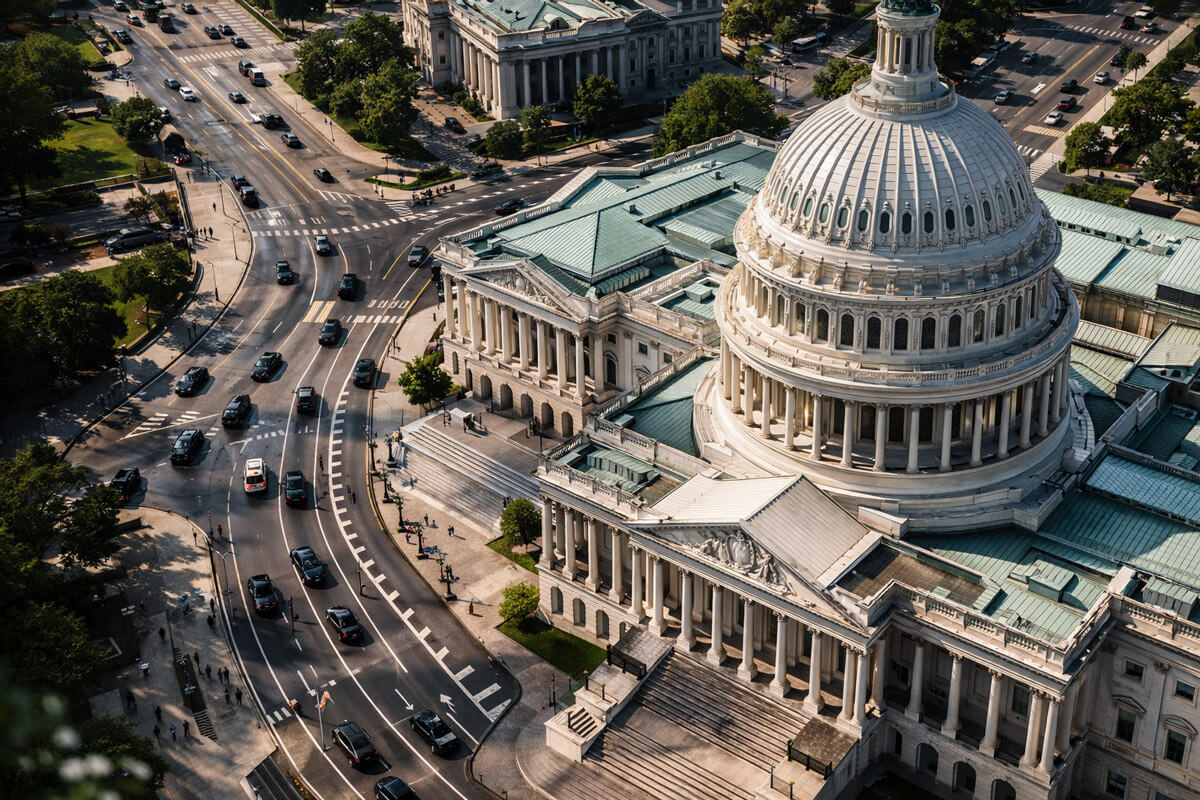
Capitol building with flags waving under cloudy sky
On April 8, Treasury Secretary Scott Bessent posted on X: "Congress has spent the better part of half a decade trying to pass a framework to onshore the future of finance. It is time for the Senate Banking Committee to hold a markup and send the CLARITY Act to President Trump's desk." This public statement, immediately backed by executives like Ripple's Brad Garlinghouse and ARK Invest's Cathie Wood, reflects the strategic urgency of the moment. The legislation, which passed the House with a historic bipartisan 294-134 vote in July 2025, has languished in the Senate for nine months due to intense lobbying wars over yield-bearing stablecoins, representing one of the longest legislative stalemates in modern financial regulation history.
“The White House methodically dismantled traditional banking's key economic argument, removing political cover for hesitant Republicans and forcing a binary decision on the regulatory future.”
On-Chain Data
On-Chain Data
The economic analysis published by the White House Council of Economic Advisers provides concrete data that dismantles banking lobby arguments:
Legislative stalemate: The CLARITY Act has been stalled in the Senate for 9 months after passing the House with 294 votes, representing the longest stalemate period for any major financial legislation since the Dodd-Frank Act.
Minimal credit impact: Banning stablecoin yields would increase total US bank lending by just $2.1 billion, a figure representing less than 0.5% of the average annual credit growth in the US banking sector.
Lending market context: In the context of the $12 trillion US lending market, that represents a negligible 0.02% shift, equivalent to approximately two hours of normal lending activity in the national banking system.
Community banks: Smaller institutions would gain just $500 million if yields were prohibited, distributed among over 4,000 community banks for an average impact of $125,000 per institution.
Consumer welfare loss: Prohibiting yields would impose an $800 million annual welfare loss on American consumers, primarily affecting middle-income households using stablecoins as savings alternatives.
Capital flows: Treasury data shows only 3.2% of total bank deposits are in accounts directly competing with yield-bearing stablecoin products, significantly limiting mass flight risk.
stablecoin data visualization showing historical growth and projections
Market Impact and Political Context
The public dismantling of banking lobby economic arguments fundamentally changes the political calculus in the Senate. For months, traditional banking groups had argued that allowing stablecoins to pay interest could trigger massive deposit flight, crippling traditional lending and threatening financial system stability. The White House Council of Economic Advisers' 48-page report demolished that narrative with rigorous econometric analysis, demonstrating that even in the most pessimistic scenario, the impact would be marginal at best.
This strategic move removes crucial political cover for Senate Republicans who have hesitated to advance the bill, particularly senators from states with strong banking presence like North Carolina and Ohio. It frames the delay not as a matter of systemic economic protection, but as the entrenchment of the financial status quo at the expense of American innovation and technological sovereignty. Notably, President Donald Trump had previously amplified the administration's stance, publicly criticizing traditional banks for obstructing legislation and accusing the banking sector of holding the CLARITY Act "hostage" to narrow corporate interests.
The timing is critically important. With the 2026 midterm elections rapidly approaching, the legislative window is closing at an accelerated pace. Political analysts estimate that after the summer recess, Congressional attention will shift completely to election campaigns, making any substantive legislative action impossible. If the Senate doesn't act in the coming weeks, the entire five-year regulatory effort could collapse, leaving the $2.4 trillion crypto market in its current regulatory limbo for another two years minimum, until after the 2028 presidential elections. James Thorne, chief marketing strategist at Wellington Altus, noted that "the entrenchment of the status quo has significantly impeded the societal integration of blockchain technology and allowed jurisdictions like the EU and Singapore to take global regulatory leadership," underscoring what's at stake beyond market numbers.
Your Alpha: Strategies for Navigating Regulatory Uncertainty
Your Alpha: Strategies for Navigating Regulatory Uncertainty
This week's coordinated pressure creates a make-or-break scenario for crypto regulation, with significant implications for institutional and retail portfolios. Traders and investors should prepare for significant regulatory volatility in the coming weeks as the Senate decides whether to act, with potentially sharp price movements in response to each political development.
1Position Bitcoin exposure as regulatory safe haven: If CLARITY passes, Bitcoin becomes the clearest institutional winner with a formalized regulatory framework that eliminates legal uncertainty. Consider increasing BTC allocation in institutional portfolios from the current 5-10% to 15-20%, prioritizing regulated vehicles like Bitcoin ETFs that would benefit directly from regulatory clarity. Historical data shows Bitcoin typically outperforms other crypto assets during periods of positive regulatory advancement.
2Monitor yield-bearing stablecoin protocols for tactical opportunities: Protocols offering stablecoin yields like MakerDAO, Aave, and Compound could see a 30-50% rally if the regulatory threat is removed, according to analysis from multiple firms. Prepare for significant incoming capital flows by setting buy orders at key support levels and monitoring TVL (Total Value Locked) metrics in real-time to confirm institutional capital entry.
3Reduce strategic exposure to vulnerable traditional banks: Banking stocks, particularly medium-sized institutions dependent on retail deposits, could face 5-15% pressure as the credit protection argument evaporates. Consider hedges through put options on the KBW Bank Index or sector reductions, reallocating capital to fintechs and digital banks better positioned to integrate blockchain technologies.
trader analyzing multiple screens with regulatory charts and Senate data
Next Catalyst and Probable Scenarios
The Senate Banking Committee must schedule a CLARITY Act markup within the next two weeks, or definitively miss the legislative window before the summer recess. This markup would be the first substantive Senate vote on the bill and determine whether it advances to the full Senate floor with favorable recommendation, a critical step historically predictive of final legislative success.
If the committee acts positively, the full Senate would likely vote before July 4th, creating a clear path to presidential signature before the midterms. Current whip counts suggest the legislation has 52-58 supporting votes in the Senate, surpassing the 50-vote threshold considering the vice president's tie-breaking vote. If the committee resists, the administration could escalate pressure with executive orders under the Interstate Commerce Act or unilateral regulatory actions through the OCC and SEC, creating a fragmented regulatory landscape that would generate additional market uncertainty.
The Bottom Line: A Decisive Moment for Digital Finance
The Bottom Line: A Decisive Moment for Digital Finance
The Trump administration has deployed all available executive power to force a Senate vote on the CLARITY Act, using economic, political, and communication tools in an unprecedented coordinated campaign in financial regulation history. By methodically dismantling traditional banking's key economic argument with irrefutable data, they've removed the last significant barrier to regulatory reform, placing responsibility directly on the Senate.
The $2.4 trillion crypto market stands at a historic inflection point: either the Senate acts now and establishes a formal regulatory framework that could position the United States as a global leader in digital finance, or the status quo persists until 2028 minimum, ceding regulatory ground to international competitors. Traders should prepare portfolios for both outcomes through hedging strategies and dynamic allocation, with Bitcoin positioned as the biggest beneficiary in case of passage due to its status as an institutionally recognized digital store of value. The next two weeks will determine not only the immediate regulatory future, but the global competitive trajectory of the American blockchain industry for the coming decade.