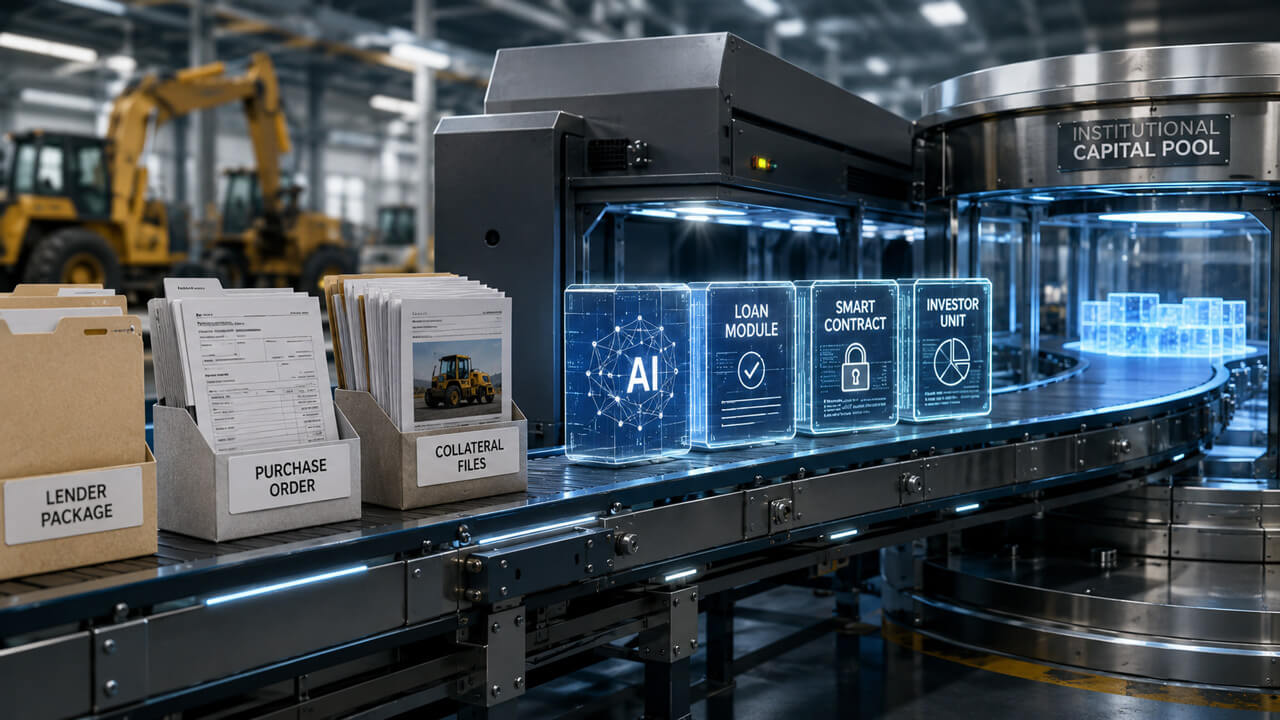
A private-credit experiment is moving from tokenized portfolios into real-business lending. Equipment-financing lender Trad.Fi and autonomous-finance platform W3 are targeting a $650 million pipeline of U.S. equipment loans that could use AI to compress credit review from months into a single day while moving parts of the capital workflow onto blockchain rails. The plan targets U.S. equipment financing for sectors including manufacturing, industrial electrical infrastructure, and residential solar, with AI assessing risk, conducting due diligence, and pricing loans quickly enough to compress a process that can take months into a single day for small and mid-sized businesses. That makes the project a clearer real-world asset test than another tokenized fund wrapper. Tokenization can record ownership and move investor interests across programmable rails. Repayment, collateral value, lien enforceability, and investor exits still depend on credit work outside the token itself. Related Reading RWA tokenization nears $30 billion, but DeFi is capturing only a fraction Only $2.47 billion of nearly $30 billion in tokenized RWAs is active in DeFi, showing how compliance rails still limit open-market use. May 18, 2026 · Gino Matos Trad.Fi presents itself as a platform connecting borrowers and lenders to make equipment finance faster and more accessible. W3 describes its product as an operating system for autonomous finance, built to bridge legacy systems to digital rails and give enterprises control over agent-powered financial workflows. The overlap is clear: equipment finance has paperwork, fragmented data, manual review, and private capital pools. W3 is pitching automation and auditability for financial workflows. Speed can change the borrower experience, while the credit product remains exposed to underwriting, collateral, servicing, and liquidity tests. Underwriting remains the bottleneck Trad.Fi's borrower-facing materials say the platform sources capital from private institutions, analyzes borrower data in minutes, extracts information from equipment purchase orders, and sends applications for review by partner credit institutions in the United States. Its lending page says accredited investors can access private lending pools that finance equipment-backed loans, with risk assessment using proprietary algorithms and external assessment from U.S. credit reporting agencies and financial institutions. The borrower and lender pages put the real test on the credit file. The project turns on whether a lender can automate enough underwriting work to make equipment financing move at software speed while preserving the judgment that keeps private credit from becoming mispriced debt. Equipment finance differs from tokenized Treasuries or tokenized public stocks. A Treasury fund depends on custody, compliance, transfer rules, and redemption mechanics around highly standardized assets. An equipment loan depends on borrower cash flow, the value and resale market for the equipment, lien documentation, insurance, servicing, repossession, and recovery if the borrower stops paying. The U.S. equipment-finance market is large enough for the experiment to matter. The Equipment Leasing and Finance Association says $1.34 trillion of U.S. equipment and software investment was financed in 2023, and more than 8 in 10 U.S. companies use some form of financing when acquiring equipment. Against that market, a $650 million four-year target is modest. It is still large enough to test whether tokenized private credit can move out of portfolio wrappers and into operating-company lending. The reported structure also carries an important caveat. The initial phase is expected to rely on institutional capital from traditional private-credit lenders to fund most underlying equipment loans directly offchain, while the companies work on bridge technology and a tokenized liquidity pool for eligible investors' exposure to equity portions of the credit generated by the process. [image: crypto trading floor] > The real test isn't whether tokenization works, but whether AI can underwrite equipment loans accurately enough to replace manual review. ## On-Chain Data - Market size: $1.34 trillion in U.S. equipment and software investment financed in 2023, per ELFA. - Project target: $650 million in equipment loans over four years, a fraction of the total market. - RWA DeFi penetration: Only $2.47 billion of nearly $30 billion in tokenized RWAs is active in DeFi, showing the gap between issuance and open-market use. - Business adoption: Over 80% of U.S. companies use financing for equipment purchases, per ELFA. [image: on-chain data dashboard] ## Market Impact If Trad.Fi and W3 succeed, the impact would be twofold: demonstrating that tokenized private credit can work for operating loans, not just synthetic portfolios, and validating that AI can replace parts of the underwriting process without increasing default risk. The equipment finance market is huge but fragmented and slow. The promise of compressing credit review from months to a day could unlock pent-up demand from small and mid-sized businesses that need equipment quickly. However, skepticism is healthy. Tokenization solves ownership transfer and settlement problems, but it doesn't eliminate underlying credit risk. A poorly underwritten loan is still bad even if tokenized. The initial hybrid structure (offchain loans funded by institutional capital, with tokenized exposure only for equity portions) suggests the creators are aware of the limitations. The real breakthrough would be when the loans themselves are issued and serviced onchain, with smart contracts handling payments and collateral. That is still far off. ## Your Alpha 1. Monitor pipeline progress: If Trad.Fi and W3 deploy a significant portion of the $650 million, it will be a signal that tokenized private credit is maturing. 2. Watch credit quality: The default rate on these loans will be the key metric. If it's comparable or better than traditional private credit, the AI thesis strengthens. 3. Look for infrastructure plays: Projects building bridges between traditional finance and blockchain (like W3) could see increased interest if this experiment succeeds. [image: trader analyzing charts] ## Next Catalyst The next milestone will be the deployment of the first tranche of loans, expected by late 2026. If Trad.Fi and W3 announce successful closings, it could trigger a wave of institutional interest in tokenized private credit. Also watch for regulatory response. The SEC and other regulators have shown interest in RWAs, and a tokenized loan product could attract scrutiny on how these assets are classified and treated. --- ## The Bottom Line Trad.Fi and W3's experiment is one of the most concrete attempts to move tokenized private credit beyond portfolio wrappers. Success depends on AI's ability to underwrite equipment loans accurately and the market's willingness to accept a hybrid structure. If it works, it could open a new channel for private credit to flow into the real economy via blockchain rails. If it fails, it will be a reminder that tokenization is not a magic wand for credit risk. For now, the market watches.