Crypto Futures: How Derivatives Markets Amplify 'Scam Coin' Schemes an
RAVE collapsed 95% after hitting $6.7B valuation, with futures volume 24.7x higher than spot. This case exposes a structural crisis where derivatives outpace ef
"Markets where derivative exposure outgrows the effective float's value make manipulation a mathematical consequence, not a theoretical possibility."
On April 18, 2026, the RAVE token experienced one of the most spectacular collapses in recent cryptocurrency history, losing 95% of its valu...
The pattern observed in RAVE repeats across multiple tokens with similar characteristics: supply concentrated in few hands, thin float (the ...
On April 18, 2026, the RAVE token experienced one of the most spectacular collapses in recent cryptocurrency history, losing 95% of its value within hours after briefly reaching a $6.7 billion market valuation. This event was not an isolated accident but the most visible manifestation of a structural crisis affecting crypto markets: the growing disconnect between spot markets and derivatives markets. When futures volumes consistently outpace spot volumes by orders of magnitude, conditions are created where price manipulation ceases to be a theoretical possibility and becomes an inevitable mathematical consequence.
The pattern observed in RAVE repeats across multiple tokens with similar characteristics: supply concentrated in few hands, thin float (the portion of tokens actually available for trading), and active perpetual markets where traders can take leveraged positions. These combined elements create a powder keg where any spark—whether a significant spot market purchase or a forced liquidation in the derivatives market—can trigger extreme price movements that benefit those controlling the supply at the expense of retail and institutional traders.
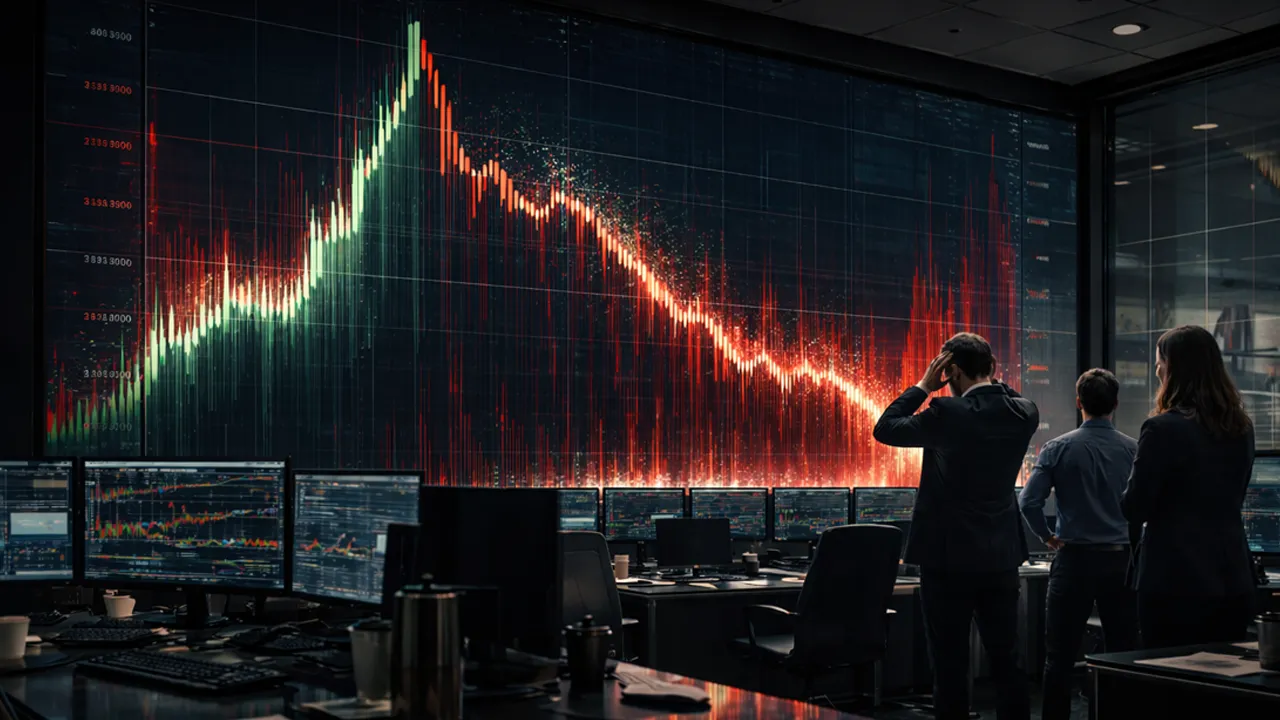
RAVE price chart collapsing with lines showing liquidation points
The Structural Signal
Cryptocurrency markets face an infrastructure crisis where derivative instruments have grown faster than the governance and oversight mechanisms that should regulate them. The RAVE case of April 18, 2026 represents only the tip of the iceberg of a phenomenon that has been developing for years. Since 2023, we've observed how trading volumes in perpetual futures have consistently surpassed spot volumes on major exchanges, creating a layer of speculation that operates with different logic than the underlying market.
What makes this imbalance particularly dangerous is how it interacts with tokens that have structurally vulnerable characteristics. When a token has over 70% of its supply concentrated in fewer than 10 wallets—as ZachXBT alleged in the RAVE case—and simultaneously develops an active futures market, an asymmetry of information and power is created that can be systematically exploited. Majority holders know exactly how much supply they have available, while traders in the derivatives market operate with incomplete information about the true liquidity of the underlying asset.
The market infrastructure surrounding RAVE consisted of three interconnected elements that created the conditions for collapse: an extremely thin float, hyper-concentrated supply, and an active perpetual market that amplified both the initial rally and subsequent destruction. ZachXBT, the on-chain investigator, alleged that insiders controlled over 90% of RAVE's total supply, with approximately 75% in a single wallet and another 10% distributed across two connected wallets. This level of concentration isn't simply concerning—it's structurally dangerous when combined with derivatives markets.
“"Markets where derivative exposure outgrows the effective float's value make manipulation a mathematical consequence, not a theoretical possibility."”
This fundamental imbalance creates what economists call "market failure": a situation where normal price discovery mechanisms cease to function because one party has disproportionate information and control. In RAVE's case, when open interest in futures reached $105.7 million, exceeding the $93.8 million effective float, the price stopped being determined by the actual supply and demand for the token and became a function of leveraged positions in the derivatives market.
on-chain data dashboard showing wallet concentration and futures/spot ratios
On-Chain Data Evidence
On-Chain Data Evidence
On-chain data provides the clearest evidence of the structural imbalances that led to RAVE's collapse and that continue to exist in other tokens. These metrics aren't mere statistics—they're early warning signals that traders can monitor to assess an asset's real risk.
RAVE Concentration: According to ZachXBT's investigation, over 90% of total supply was controlled by insiders, with 75% concentrated in a single wallet. This concentration level creates extreme counterparty risk, where a single actor can disproportionately influence price.
Futures/Spot Ratio: CoinGlass data shows a 24.7x ratio, with $3.36 billion in futures volume versus only $138.9 million in spot volume post-collapse. When this ratio exceeds 10x, it indicates the derivatives market is operating with logic separate from the underlying market.
Open Interest vs. Float: With $105.7 million in open interest exceeding RAVE's $93.8 million effective float, a situation was created where there was more financial exposure to the token in derivatives than actual tokens available for trading. This is the precise mathematical condition that makes squeezes possible.
Repeat Pattern in Other Tokens: SIREN showed a 40.5x futures/spot ratio before its own collapse, while ARIA maintains a 12.0x ratio even after losing 91% of its value. These aren't isolated incidents but manifestations of a market pattern.
Negative Funding Rates as Signal: SIREN registered a -0.2989% funding rate, a clear signal of crowded short positions creating conditions for cascade liquidations. Persistent negative funding rates indicate traders are paying to maintain short positions, which can create cumulative pressure.
What this data collectively reveals is an ecosystem where tokens with weak structural characteristics are being amplified by derivatives markets operating with their own logic. When open interest in futures exceeds the effective float's value, as happened with RAVE, price determination shifts primarily to the derivatives layer rather than the spot market. This creates conditions where those controlling spot supply can strategically choose when to execute squeezes, turning what should be a market into a zero-sum game where retail traders are structurally disadvantaged.
comparison of multiple tokens showing futures/spot ratios and concentration
Market Impact and Regulatory Response
Exchanges face growing and unprecedented regulatory pressure following these events. The coordinated response of major platforms to the RAVE case suggests they recognize the systemic risk these schemes represent. Binance and Bitget actively investigated the case, while OKX offered a $25,000 bounty to support ZachXBT's investigation. This isn't a casual response—it's tacit recognition that exchanges have responsibility for their markets' integrity.
Binance's March 25, 2026 guidelines already explicitly warned about three red flags that exactly match what was observed in RAVE: coordinated sell-offs that don't match fundamentals, volume that doesn't correlate with price behavior, and shallow order books that facilitate artificial price manipulation. What's significant is that these guidelines existed before RAVE's collapse, suggesting exchanges were aware of the risks but hadn't implemented sufficient preventive controls.
For the broader cryptocurrency ecosystem, these events have profound implications. First, they erode confidence in altcoin markets, making both institutional and retail traders more cautious about any token that isn't Bitcoin or Ethereum. Second, they highlight the urgent need for better price discovery mechanisms that can't be easily manipulated. Third, they create pressure for stricter regulation that could negatively affect legitimate projects alongside fraudulent schemes.
The most insidious impact, however, is how these events distort capital allocation within the ecosystem. When traders learn they can make more money identifying and exploiting these patterns than investing in projects with solid fundamentals, capital flows toward extractive rather than productive activities. This creates a vicious cycle where the ecosystem's overall quality degrades, making it harder for legitimate projects to attract investment.
Your Alpha: Practical Strategies for Navigating This Environment
Your Alpha: Practical Strategies for Navigating This Environment
Institutional and retail traders must develop rigorous frameworks for assessing risk before trading any token with active futures markets. Supply concentration, futures/spot ratios, and funding rates aren't abstract metrics—they're early warning signals that can mean the difference between a successful trade and catastrophic losses.
1Monitor wallet concentration with specific tools: Use tools like Nansen, Arkham Intelligence, or Etherscan to track token distribution. Any token with over 70% of its supply in fewer than 10 wallets presents extreme risk, especially with active perpetual markets. Set alerts for significant distribution changes that might indicate squeeze preparations.
2Calculate critical ratios before entering any position: Develop a spreadsheet or dashboard that automatically calculates two key ratios: (a) open interest as a percentage of effective float, and (b) futures volume versus spot volume. When open interest exceeds 50% of effective float or futures volume surpasses 10x spot volume, the market is structurally exposed to squeezes. Consider these conditions as "do not trade" signals.
3Interpret funding rates in context: Persistent negative funding rates (-0.1% or deeper) indicate crowded short positions that can trigger cascade liquidations with small price movements. Monitor not just the absolute level of rates, but also their trend and how they compare to historical periods. A rate that suddenly becomes more negative may indicate a squeeze is being prepared.
4Diversify your exposure temporally: Instead of maintaining constant positions in high-risk tokens, consider entry and exit strategies based on market conditions. Reduce exposure when ratios indicate high squeeze risk, and increase only when fundamentals and on-chain metrics support a genuine investment thesis.
trader analyzing multiple dashboards with real-time on-chain metrics
Next Catalysts and Market Trends
Regulatory scrutiny will intensify significantly during the second and third quarters of 2026. Exchanges will face pressure not only from traditional regulators like the SEC and CFTC, but also from their own users and the broader cryptocurrency community. Existing guidance, like Binance's warnings about coordinated sell-offs and shallow order books, will likely become formal requirements with real consequences for non-compliant exchanges.
Expect to see three key developments in the coming months: First, exchanges will implement stricter controls on listings of tokens with concentrated supply, particularly those with active derivatives markets. This could include minimum distribution requirements, longer lock-up periods for insiders, and limits on available leverage for specific tokens. Second, regulators will issue more specific guidance on how exchanges should monitor and prevent manipulation in derivatives markets. Third, we'll see class action lawsuits against exchanges for failing to adequately protect users from these schemes.
Protocol developers will also respond to this pressure with better token distribution mechanisms and more transparent vesting schedules. Projects that can demonstrate broad distribution and genuine float will earn confidence premiums in markets, while those with opaque structures will face increasing difficulties listing on major exchanges. This dynamic will create a bifurcation in the ecosystem between "clean" projects with transparent governance and "dirty" projects operating at the margins.
Meanwhile, traders will continue hunting these patterns in emerging tokens, creating cycles of early identification and exploitation that maintain pressure on regulators and exchanges. The irony is that this trading activity, while profitable for some, contributes to the systemic problem by providing liquidity and volume to tokens that would otherwise collapse from lack of genuine interest.
The Bottom Line: Navigating the New Market Reality
The Bottom Line: Navigating the New Market Reality
RAVE, SIREN, and ARIA represent three different moments of the same destructive cycle: the investigative structure that identifies risk, the squeeze in progress that creates temporary gains for some and permanent losses for many, and the post-dump residue where only the lessons learned (or not learned) remain. The data is unequivocal: when futures markets grow faster than underlying spot markets, and when this dynamic combines with concentrated supply and thin float, manipulation ceases to be a possibility and becomes a mathematical certainty.
For traders, the implication is clear: they must prioritize tokens with genuine distribution and avoid those where derivative open interest exceeds effective float. This requires a fundamental shift in how we evaluate crypto assets—from focusing primarily on narratives and momentum to meticulously analyzing underlying supply and demand structures. The on-chain tools already exist to do this analysis; what's missing is the discipline to use them consistently.
The market is moving inevitably toward greater transparency and accountability, but this transition will be messy and costly. Until it arrives, self-protection through rigorous on-chain analysis remains the most effective strategy. Traders who develop the ability to identify and avoid these patterns will not only protect their capital but will also be better positioned to capitalize on the genuine opportunities that will inevitably emerge in a healthier, more transparent ecosystem.