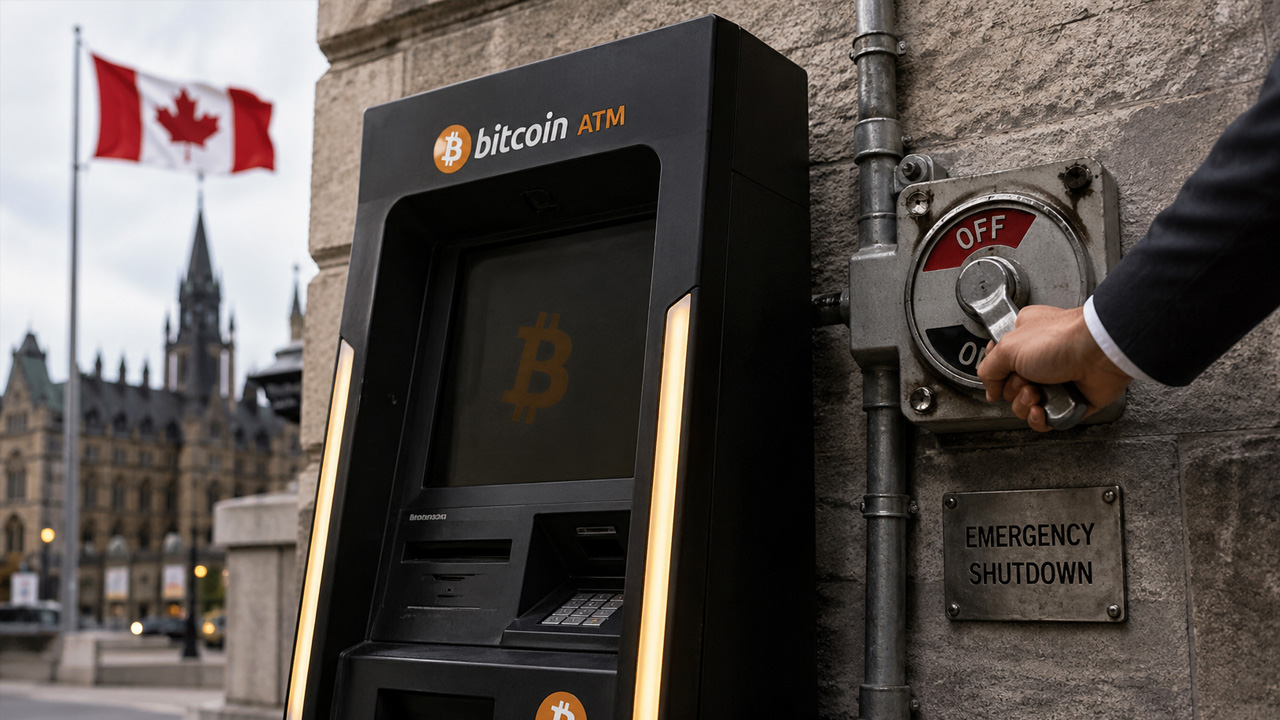
"Crypto ATMs are a primary method for scammers to defraud victims and for criminals to place their cash proceeds of crime." — Spring Economic Update 2026
Canada wants to ban crypto ATMs. Thirteen years after installing the world's first machine in a Vancouver coffee shop, the federal governmen...
Canada has nearly 4,000 crypto ATMs, the highest concentration per capita globally. These machines, located in convenience stores and gas st...
Canada wants to ban crypto ATMs. Thirteen years after installing the world's first machine in a Vancouver coffee shop, the federal government is proposing to eliminate them entirely. The reason: over $2.4 billion in fraud losses since 2022, according to the Spring Economic Update 2026.
The Signal
Canada has nearly 4,000 crypto ATMs, the highest concentration per capita globally. These machines, located in convenience stores and gas stations, allow users to convert cash into bitcoin without a bank account. For transactions under $1,000, only a phone number is required. That combination of physical visibility and low verification makes them an easy political target.
bitcoin atm in a convenience store with a customer using it
Canadians reported losing more than $704 million to fraud in 2025 alone. The government estimates that only 5-10% of fraud incidents are reported, meaning real losses are likely much higher. FINTRAC, Canada's financial intelligence agency, had already identified crypto ATMs as the "primary method" for fraudsters to collect and launder funds in a 2023 analysis. The ban proposal didn't come out of nowhere: both Finance Minister François-Philippe Champagne and FINTRAC declined interview requests from CBC News last fall. The Spring Economic Update was their answer.
“"Crypto ATMs are a primary method for scammers to defraud victims and for criminals to place their cash proceeds of crime." — Spring Economic Update 2026”
The broader context is important. Since 2022, crypto-related frauds have surged in Canada, and ATMs have become the preferred channel for scammers due to their relative anonymity and the difficulty of tracing transactions. The total ban proposal reflects growing frustration among regulators, who see existing measures as insufficient. The question is whether this drastic step will actually solve the problem or merely shift fraudulent activity to other channels, such as peer-to-peer platforms or decentralized exchanges.
On-Chain Data
On-Chain Data
Reported losses: Canadians lost over $704 million to fraud in 2025, bringing total reported losses since 2022 to over $2.4 billion.
Underreporting: The government estimates only 5-10% of fraud incidents are reported, implying real losses could be 10-20x higher.
ATM concentration: Canada hosts nearly 4,000 crypto ATMs, the highest per capita density in the world.
Fraud dependency: Nearly a dozen former employees of crypto ATM operators told CBC News that these companies would not be profitable without fraud-linked transactions.
These data points reveal an uncomfortable truth: a significant portion of crypto ATM transaction volume may be driven by illicit activity. The dependency on fraud suggests that the business model is inherently fragile, and any attempt to regulate more strictly could make them economically unviable. The ban proposal, therefore, is not just about consumer protection but also reflects a judgment that the sector cannot be reformed without eliminating its main revenue source.
fraud loss chart canada from 2022 to 2025 showing steep increase
Market Impact
The proposed ban would eliminate one of the most accessible on-ramps to bitcoin for millions of unbanked or underbanked Canadians. Unlike online exchanges, ATMs require no ID for small amounts, making them popular among informal workers, immigrants, and rural residents. For these groups, the disappearance of crypto ATMs could mean even greater financial exclusion, as they lack easy alternatives to acquire cryptocurrencies.
For ATM operators, the measure would be existential. Companies like Bitcoin Depot (BTM), CoinFlip, and LocalCoinATM would lose a key market. The industry already faced regulatory pressure in the U.S., where California capped daily transactions at $1,000 in 2023. But a total ban is a far bigger blow. Bitcoin Depot's stock could be particularly affected, given its significant exposure to the Canadian market. Investors should brace for potential volatility if the ban progresses.
The precedent is dangerous for the broader crypto ecosystem. If regulators can eliminate a physical product due to fraud association, what stops them from targeting decentralized exchanges or non-custodial wallets? The narrative that "crypto is a tool for criminals" gains political power when the target is tangible and easy to explain. Moreover, other countries with high ATM density, such as the U.S., Australia, and the U.K., may follow Canada's lead, triggering a regulatory domino effect. The crypto community must watch these moves closely and prepare defense strategies.
Your Alpha
Your Alpha
1Watch ATM operator stocks: Publicly traded companies like Bitcoin Depot (BTM) could see sharp declines if the ban progresses. Consider short positions or hedges. Also monitor news about potential legal challenges from the industry, which could create short-term volatility.
2Look for frictionless alternatives: If Canada shuts down ATMs, demand may shift to peer-to-peer exchanges or DeFi protocols with stablecoin integration. Monitor volumes on platforms like Bisq or LocalBitcoins. New solutions may emerge, such as mobile apps that facilitate cash-to-crypto purchases through partnered retail networks.
3Prepare for regulatory ripple effects: Other countries with high ATM density (U.S., Australia, U.K.) may follow Canada's lead. Diversify geographic exposure in crypto investments. Also consider the possibility that regulation could extend to other high-risk crypto products, such as algorithmic stablecoins or unregulated exchanges.
trader analyzing crypto charts on multiple screens
Next Catalyst
The Canadian parliament will debate the proposal in coming months. Public and media pressure, amplified by fraud figures, makes passage likely. However, the industry may mount legal challenges, arguing the ban is disproportionate and that compliance solutions exist. The outcome of these challenges could delay or modify the ban.
Meanwhile, Canadian crypto advocacy groups like the Blockchain Association of Canada are mobilizing. The outcome hinges on whether they can convince lawmakers that ATMs can operate under stricter rules without a total ban. Alternatives could include lower transaction limits, mandatory identity verification for all transactions, or a registry of authorized operators. The key will be the industry's ability to demonstrate effective self-regulation.
The Bottom Line
The Bottom Line
Canada's proposal is a tipping point. For the first time, a developed government is moving to completely eliminate a bitcoin access channel. If approved, it signals that regulatory tolerance for high-fraud crypto products is running out. For investors, the lesson is that physical crypto infrastructure is vulnerable to direct political action. The next battle isn't in courtrooms—it's in parliament. The industry must adapt quickly, seeking more sustainable business models and complying with regulations, or face extinction in key markets. The future of bitcoin access may depend on the community's ability to demonstrate that the technology can be used safely and responsibly, without resorting to extreme measures like total bans.