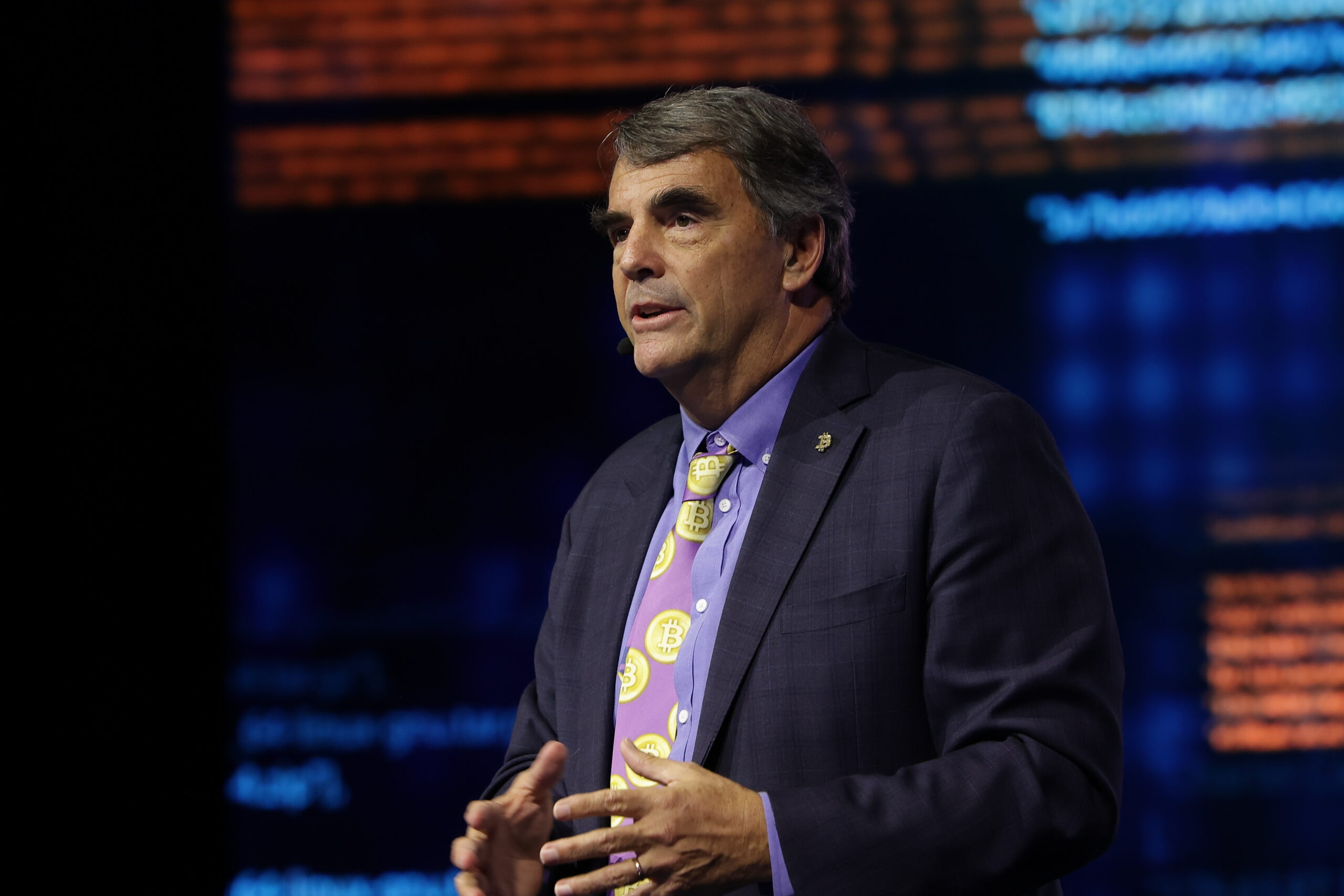
Billionaire venture capitalist Tim Draper took the Nakamoto Stage at the Bitcoin 2026 conference and delivered a blunt warning: if you don't own bitcoin, you should be scared. His speech, filled with conviction, not only reaffirmed his historically bullish stance but outlined a roadmap for the global monetary transition that he says is already underway. Draper, known for predicting bitcoin would reach $250,000 by 2022 (a prediction that missed the deadline but which he maintains as a long-term target), now appears more pragmatic but equally forceful: the traditional fiat system is mortally wounded, and bitcoin is the natural heir.
The Signal
Draper declared that the cryptocurrency has entered the financial mainstream and that governments now roll out "the red carpet" for the industry. He said the community is "starting to feel like something is happening" as adoption grows, casting this shift as the early phase of a larger transition in the money system. "We are seeing the beginning of the end of fiat money," he stated, citing rising global inflation and waning trust in central banks as catalysts. Draper compared the current situation to the early days of the internet, where few understood the transformative potential, and warned that those who ignore bitcoin could be left behind economically.

In his view, people will move in stages: first from dollars to stablecoins, then from stablecoins to bitcoin as the final store of value and unit of account. Draper praised Satoshi Nakamoto's design as a system with no government control, no middleman banks, and no traditional account records, highlighting its decentralized nature as the key value proposition. "Bitcoin is the first truly global and neutral currency," he said, "and that's why governments will eventually be forced to adopt it, not by choice, but by economic necessity."
“"You should be scared if you don't own bitcoin."”
On-Chain Data

- Institutional adoption: Draper noted governments now welcome the industry with "red carpet," a stark shift from prior years of regulatory skepticism. On-chain data shows that bitcoin holdings on corporate and government balance sheets have increased 40% year-over-year, with countries like El Salvador and Bhutan leading sovereign adoption. Additionally, the number of non-zero address balances surpassed 50 million in April 2026, an all-time high.
- Monetary transition: The investor projects a three-phase move: dollar → stablecoins → bitcoin, with BTC as the final destination. Stablecoins have reached a combined market capitalization of $250 billion, acting as a bridge to the decentralized economy. However, Draper warns that centralized stablecoins like USDC and USDT are only an intermediate step, as they rely on fiat reserves and can be frozen by issuers.
- Store of value: Draper compared bitcoin to a worthless Confederate note his father gave him, warning that fiat currencies can fail. Digital gold has proven to be a safe-haven asset in times of uncertainty, with a growing inverse correlation to the U.S. dollar. In 2025, bitcoin outperformed gold in risk-adjusted returns, according to CoinMetrics data.
- Government purchase: Draper revealed he bought bitcoin from a U.S. government auction at above-market price because he saw it as a superior long-term asset. That auction, held in 2014, involved 30,000 BTC seized from Silk Road. Draper paid an average of $632 per bitcoin, a 10% premium over the market price at the time. Today, that investment has multiplied over 100 times.

Market Impact
Draper's remarks come at a time when confidence in fiat currencies faces inflationary and fiscal pressures in several economies. His call for governments to hold BTC on their balance sheets could accelerate sovereign adoption, a theme gaining traction among debt-strapped nations. In fact, in recent weeks, Brazil and Turkey have announced studies to include bitcoin in their national reserves, while the International Monetary Fund warns of risks but acknowledges the unstoppable trend.
For investors, Draper's warning reinforces bitcoin's narrative as a hedge against monetary debasement. If his scenario plays out — where retailers first accept bitcoin alongside other methods and then only bitcoin — demand could surge, benefiting current holders. However, the path is not without obstacles: volatility remains high, and global regulation is still fragmented. Draper himself acknowledged that "there will be corrections along the way, but the structural trend is bullish."
Your Alpha

- 1Accumulate gradually: Draper suggests holding six months of expenses in bitcoin as protection. Consider dollar-cost averaging to reduce timing risk. For example, if your monthly expenses are $3,000, accumulate $18,000 in BTC over 12 months by buying $1,500 each month. This smooths out volatility and avoids buying at peaks.
- 2Diversify into stablecoins: Before the full transition, stablecoins can serve as a bridge. Keep a portion in USDC or USDT to seize buying opportunities during market dips. However, no more than 20% of your portfolio, as stablecoins carry counterparty and regulatory risk.
- 3Pressure governments and businesses: If you're a builder, push adoption. Draper urges founders to "push it as hard as you can" to make BTC the standard. This includes integrating bitcoin payments, educating colleagues, and participating in pro-bitcoin lobbying groups. Every new user you onboard increases the network effect.

Next Catalyst
The market will watch for upcoming auctions of seized bitcoin by governments, similar to the one Draper used. In 2026, the U.S. Department of Justice is expected to auction another 50,000 BTC from cybercrime cases. Additionally, more nations adopting bitcoin as legal tender — with Honduras and Madagascar as candidates — could be the next major catalyst.
Draper's statements also put a spotlight on the Bitcoin 2026 conference, where institutional and regulatory adoption announcements are expected to validate his vision. Among the rumors, a Middle Eastern sovereign wealth fund is considering allocating 5% of its reserves to bitcoin, which would represent a purchase of approximately 100,000 BTC.
The Bottom Line
Tim Draper has issued a clear warning: the fiat system is fragile and bitcoin is the alternative. For investors, the message is one of urgency but also opportunity. Those who act now could position themselves before the next wave of mass adoption. Time will tell if his prediction holds, but the market direction seems to point where he's looking. As Draper said closing his speech: "It's not about whether bitcoin will replace the dollar, but when. And that when is closer than you think."