Bitcoin Miners: AI Pivot Threatens Network Security, But BTC Revenue t | ChainPulse
Bitcoin
Bitcoin Miners: AI Pivot Threatens Network Security, But BTC Revenue t
Bitcoin's average production cost hit $79,995 in Q4 2025 as AI/HPC contracts exceed $70B. Industrial miners reallocate power, creating security risks but mainta
AI is already signing leases and converting facilities, while quantum remains on the roadmap.
Bitcoin trades at $77,845 after gaining 9.2% over 30 days. The market's surface strength masks real economic pressure on the mining side tha...
Bitcoin's price shows recovery, but mining data reveals deep structural tensions. The quantum threat narrative, while valid long-term, has b...
Bitcoin trades at $77,845 after gaining 9.2% over 30 days. The market's surface strength masks real economic pressure on the mining side that's reshaping the industry. While prices show resilience, fundamental data reveals that industrial mining is undergoing its most significant transformation since the post-2024 halving consolidation. Competition for energy resources no longer comes only from other miners, but from an entirely different sector: high-performance artificial intelligence (HPC/AI). This convergence is redefining the value of mining assets, network security, and the business models of public mining companies.
The Signal
Bitcoin's price shows recovery, but mining data reveals deep structural tensions. The quantum threat narrative, while valid long-term, has been displaced by a more immediate and economically tangible competitor: artificial intelligence. While IBM targets fault-tolerant quantum computers by 2029, AI is already competing for the same energy resources that made industrial miners valuable. The crucial difference is temporal: AI is signing contracts today, while quantum computing remains primarily a research roadmap.
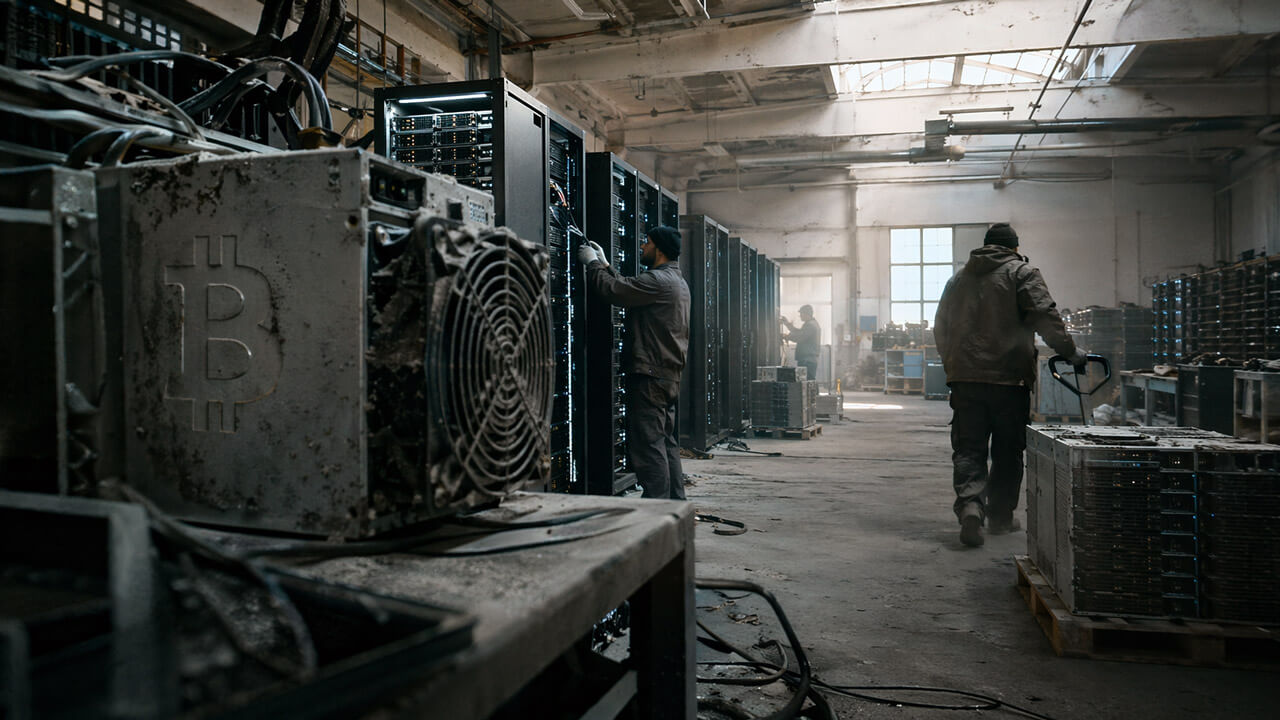
bitcoin mining facility with equipment being reconfigured
The economic pressure is tangible and measured in dollars per megawatt-hour. CoinShares reports the weighted average cash cost to produce one Bitcoin among public miners rose to about $79,995 in Q4 2025. This number isn't a theoretical estimate, but the result of actual energy costs, ASIC equipment depreciation, operational expenses, and debt structures. With current hashprice around $30 per petahash per day, an estimated 15% to 20% of the global fleet operates underwater if power costs are high enough. This economic reality is forcing concrete operational decisions: miners are renegotiating power contracts, decommissioning less efficient equipment, and reallocating capacity to alternative uses. This isn't theoretical speculation about cryptographic futures, but business decisions affecting quarterly cash flow.
“AI is already signing leases and converting facilities, while quantum remains on the roadmap.”
The energy context is fundamental to understanding this transition. Industrial miners built their competitive advantage over years by securing access to cheap, stable power, often in regions with renewable energy surpluses or associated natural gas. These same attributes—low cost, 24/7 availability, and strategic locations—are exactly what the AI/HPC industry seeks to power its GPU clusters. The convergence isn't coincidence: it's the logical result of two energy-intensive industries competing for the same scarce resource. AI/HPC contracts offer more stable, predictable revenue than Bitcoin mining, which is subject to BTC price volatility and difficulty adjustments. For a miner facing compressed margins, the temptation to reallocate capacity is economic, not ideological.
On-Chain Data
On-Chain Data
The numbers tell a story of structural transformation. On-chain and financial data reveal clear patterns investors must understand:
Production cost: $79,995 per Bitcoin in Q4 2025 among public miners according to CoinShares. This cost includes direct operating expenses but excludes depreciation and capital expenditures, meaning the total economic cost is even higher.
Current hashprice: Approximately $30 per petahash per day. This key indicator has shown significant volatility, falling from peaks over $100/ph/day in earlier periods when BTC price was higher and difficulty lower.
Underwater fleet: 15-20% of global capacity if power costs are elevated. This percentage represents approximately 40-55 EH/s of hashrate that could be economically unviable in the current environment.
AI/HPC contracts: Over $70 billion announced across the public mining sector. These commitments include long-term agreements (5-10 years) with cloud computing companies and AI developers, offering more stable revenue streams than mining.
Leading hashrate: Bitdeer (69.5 EH/s), MARA (61.7 EH/s), CleanSpark (47.3 EH/s), IREN (43 EH/s), Riot (36.4 EH/s). These companies collectively represent over 30% of Bitcoin's global hashrate.
Reallocated capacity: Initial estimates suggest 2-4 GW of energy capacity previously dedicated to Bitcoin mining could be reallocated to AI/HPC in the next 18-24 months.
Revenue comparison: Projections indicate Bitcoin mining revenue will outpace AI by over $4 billion in 2026, but with significantly different margin profiles.
comparative chart of mining costs vs. AI revenue
Analysis of this data reveals an industry in a two-phase transition. First, miners are optimizing their existing Bitcoin operations, shutting down less efficient equipment and renegotiating power contracts. Second, they're developing dual capabilities that allow toggling between Bitcoin mining and AI compute based on market conditions. This second phase is more strategic and requires significant investments in electrical infrastructure and cooling, as well as technical expertise in both domains. Miners who successfully navigate this transition could capture significant value, while those who remain static will face increasing competitive pressure.
Market Impact
The reallocation of mining capacity toward AI represents a network security risk that investors cannot ignore. When Bitdeer begins decommissioning rigs in Tydal, Norway to make room for an AI data center, or when Core Scientific energizes 350 MW under its CoreWeave contract, we're seeing physical migration of resources previously dedicated to securing the blockchain. This trend fragments the industrial mining landscape into three clearly differentiated camps: those with real AI/HPC contracts already moving capacity (like Core Scientific and Bitdeer), those with collaboration frameworks and early pilots (like several mid-sized companies), and those still largely tied to Bitcoin (often smaller or specialized miners).
The security risk emerges from potential reduction in Bitcoin-dedicated hashrate if enough miners find better returns in AI. A declining or stagnant hashrate could make the network more vulnerable to 51% attacks, especially if concentration among remaining miners increases. However, current economic dynamics suggest Bitcoin will maintain its attractive advantage for many operators. Bitcoin mining revenue will still outpace AI by over $4 billion according to current projections. This creates a precarious balance where miners operate at the margin, seeking to optimize assets between two competitive but differently profiled risk-return markets.
MARA illustrates this hybrid approach with campuses designed to operate both Bitcoin mining and AI compute, with ability to toggle workloads depending on pricing and demand. This "toggle" model likely represents the future of industrial mining: flexible infrastructure that can allocate resources to the most profitable application at any given time. The implications for network security are complex. On one hand, toggle capability could lead to greater hashrate volatility if miners rapidly switch between Bitcoin and AI in response to price changes. On the other hand, it could increase the overall resilience of the mining sector by diversifying revenue sources, making companies more sustainable long-term.
For investors, this transition creates both risks and opportunities. Mining companies that successfully execute dual strategies could see valuation multiples expand as they're perceived as broader compute infrastructure companies, not just Bitcoin miners. Those that fail to adapt could face margin pressure and potential consolidation. Capital markets are already reflecting this divergence, with companies announcing significant AI/HPC contracts receiving re-ratings, while pure-play miners face skepticism.
Your Alpha
Your Alpha
The data shows an industry in transition where operational agility will be key to survival and success. Miners maintaining flexibility to toggle between Bitcoin and AI based on market conditions will likely capture better long-term value. MARA's ability to "toggle" workloads represents a model others may emulate, but requires significant investments in dual electrical infrastructure and technical expertise.
1Monitor announcements of mining facility conversions to AI as leading indicator of hashrate pressure. Press releases about AI/HPC contracts, especially those mentioning reallocation of existing capacity, are leading indicators of changes in Bitcoin-dedicated hashrate. Pay attention not just to contract value, but to megawatts involved and implementation timelines.
2Evaluate public miners by their exposure to AI/HPC contracts versus pure Bitcoin commitment. Create an evaluation matrix considering: percentage of capacity with dual capability, duration and value of AI contracts, energy efficiency of Bitcoin operations, and balance between stable (AI) and variable (Bitcoin) revenue. Companies with balanced mixes may offer better risk-return profiles.
3Consider that Bitcoin's economic advantage over AI (over $4B in revenue) may maintain sufficient network security incentive near-term. As long as Bitcoin mining continues to generate significantly greater revenue than AI alternatives, sufficient hashrate is likely to remain dedicated to the network. Monitor the hashprice/energy cost ratio as a key sustainability indicator.
trader analyzing mining data across multiple screens
Practical implementation of this alpha requires continuous monitoring of multiple sources: quarterly reports from public miners, on-chain hashrate and difficulty data, energy contract announcements, and AI infrastructure developments. Investors should set alerts for significant changes in any of these areas, as the transition could accelerate rapidly if economic conditions shift. Additionally, consider geographic exposure: miners in regions with very cheap power (like certain parts of Texas or Scandinavia) may maintain Bitcoin mining advantages longer, while those in more expensive energy markets might feel pressure to reallocate capacity more quickly.
Next Catalyst
The evolution of announced AI/HPC contracts, currently exceeding $70 billion, will determine the speed and scale of this transition. CoinShares will remain a key source to track how these commitments materialize into reallocated physical capacity. The Q2 2026 report will provide updated production cost and margin data, offering a clearer picture of the real economic pressure operators face.
Concurrently, IBM's roadmap toward fault-tolerant quantum computers by 2029 maintains pressure on the cryptographic horizon. Though less immediate than energy competition, this development will eventually require protocol updates investors should monitor in coming years. The Bitcoin community is already discussing potential migrations to post-quantum algorithms, but these are long-term decisions that don't affect miners' current operational choices.
An additional catalyst to watch is the evolution of energy markets. Volatile electricity prices or changes in regulatory policies could significantly alter the economic equation for miners. For example, if certain regions implement restrictions on data center energy consumption or offer incentives for AI operations over Bitcoin mining, this could accelerate the transition. Investors should monitor regulatory developments in key jurisdictions like Texas, Canada, and Nordic countries, where much industrial mining is concentrated.
The Bottom Line
The Bottom Line
Bitcoin mining faces its most pragmatic challenge since industry consolidation: direct resource competition with artificial intelligence. Data shows production costs at $79,995, hashprice at $30/ph/day, and over $70B in announced AI/HPC contracts. This reality is forcing miners to reconfigure operations, creating security risks but maintaining Bitcoin's economic advantage.
The market must prepare for a more diversified mining industry where flexibility between Bitcoin and AI becomes a key competitive advantage. The next 12-18 months will be critical in determining which companies successfully navigate this transition and which fall behind. For investors, this means evaluating miners not just by their Bitcoin hashrate, but by their ability to execute dual strategies, their access to competitive power, and their operational agility. The era of the pure-play Bitcoin miner may be giving way to the era of the flexible compute infrastructure operator, with profound implications for network security, company valuations, and the future of the mining industry as a whole.