
Cathie Wood isn't backing down. ARK Invest CEO reaffirmed a $750,000 base case for Bitcoin by 2030, with a bull case of $1,250,000, even as critics question its hedge properties amid geopolitical turmoil.
The Signal
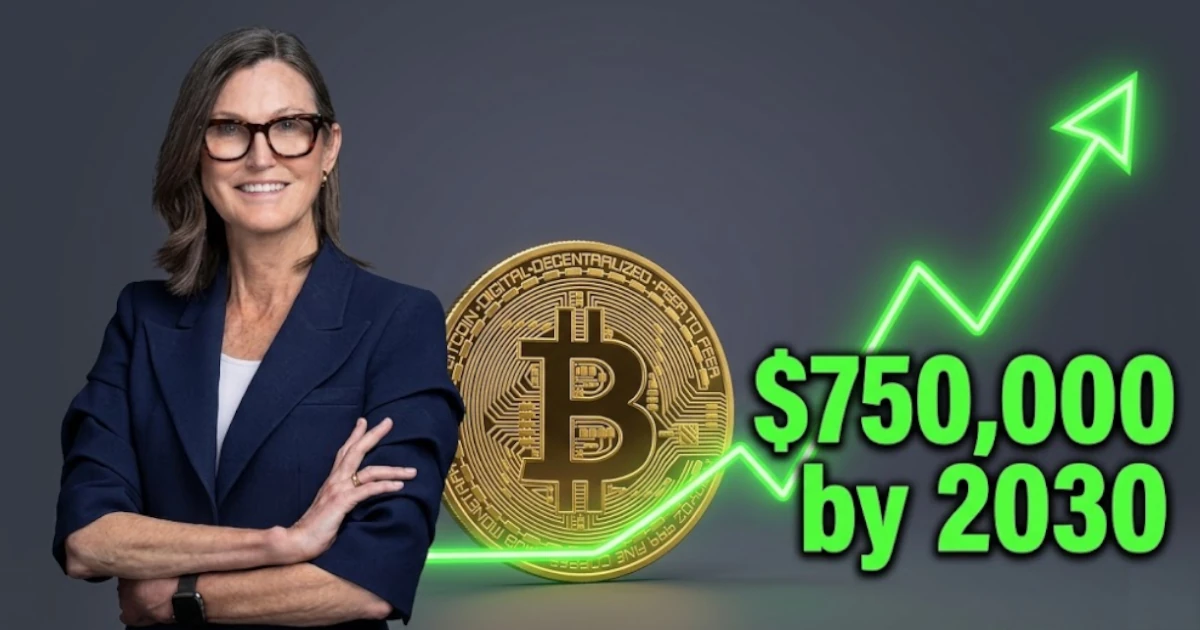
In a Fox Business interview, Wood outlined three drivers: generational wealth transfer, Bitcoin's role as insurance in emerging markets, and accelerating institutional adoption. "Our base case is closer to $750,000. But the bull case involves a substitution for gold," she said. Younger generations, inheriting trillions from baby boomers, are more likely to adopt digital stores of value.

Wood stressed Bitcoin's scarcity: "21 million units, we're up to 20 million that have been minted. Only one more million to go." Supply inflation is currently 0.9% annually, below gold's long-term average, and will halve to 0.45% in two years. She also noted a low 0.14 correlation between Bitcoin and gold since 2019, making Bitcoin a powerful diversifier.
“"Bitcoin is mathematically metered. There will be no supply response. Real scarcity value is evolving now."”
On-Chain Data

- Circulating Supply: 20 million BTC mined, with only 1 million left to issue.
- Inflation Rate: 0.9% annual supply growth, dropping to 0.45% within two years—lower than gold's historical rate.
- Bitcoin-Gold Correlation: 0.14 since 2019, nearly zero, indicating diversification benefits.
- Institutional Adoption: Wood cites this as the primary driver; low correlation improves risk-adjusted returns.
- Sanctions Use Case: Iran accepting Bitcoin for Strait of Hormuz tolls highlights utility in friction-prone cross-border trade.

Market Impact
Wood's comments counter recent skepticism from figures like Mark Cuban, who claimed Bitcoin "lost the plot" as a hedge. While gold outperformed Bitcoin during some geopolitical stress events, Wood argues structural advantages persist. Regulatory clarity in the U.S.—via the Genius Act and Clarity Act—could accelerate institutional inflows.
Bitcoin's emerging role as neutral money in global trade, exemplified by Iran's toll system, underscores its utility beyond speculation. Over 20% of global oil transits the Strait of Hormuz, and Bitcoin could facilitate transactions in sanctioned environments. This aligns with Wood's thesis of Bitcoin as insurance in emerging markets.
Your Alpha

For traders and allocators, Wood's framework offers actionable insights:
- 1Tactical Allocation: Use Bitcoin's low correlation (0.14 with gold) to diversify portfolios. A small allocation can improve risk-adjusted returns.
- 2Scarcity Play: The halving of Bitcoin's supply inflation to 0.45% in two years is a long-term bullish catalyst. Consider accumulating BTC or ETFs.
- 3Regulatory Watch: The Genius Act and Clarity Act are key catalysts. Monitor legislative progress; passage could trigger institutional FOMO.

Next Catalyst
The immediate focus is U.S. crypto regulation. The Genius Act and Clarity Act, if passed, would provide legal clarity, attracting institutional capital. Wood specifically cited these as catalysts. Additionally, geopolitical adoption—like Iran's Bitcoin payments—could accelerate if more nations seek alternatives to the dollar-based system.
The Bitcoin 2026 conference in Nashville this July may also generate positive sentiment. Wood's appearance and further institutional announcements could reinforce the bullish narrative.
The Bottom Line

Cathie Wood is doubling down on Bitcoin as a digital store of value, targeting $750,000 by 2030. The thesis rests on scarcity, institutional adoption, and generational shifts. For investors, the takeaway is patience: Bitcoin's low correlation and declining inflation make it a compelling long-term hold. Regulatory clarity and geopolitical use cases could be the catalysts that push prices higher. Position accordingly.
Additional Analysis: Market Context
ARK's forecast comes amid a period of consolidation for Bitcoin. Year-to-date in 2026, Bitcoin has traded between $60,000 and $80,000, reflecting macro uncertainty and regulatory overhang. However, spot Bitcoin ETFs in the U.S. have seen net inflows exceeding $15 billion since launch in January 2024, indicating sustained institutional demand. This contrasts with retail sentiment, which has been more cautious.
Wood's bullish stance diverges from some peers. For instance, Bridgewater Associates has expressed skepticism about Bitcoin's inflation-hedge properties. But Wood counters that Bitcoin hedges against monetary expansion, not consumer price inflation. "Bitcoin is a hedge against fiscal mismanagement," she stated.
Implications for Retail Investors
For retail investors, Wood's message is a vote of confidence but comes with caveats. Bitcoin's annualized volatility exceeds 70%, compared to 15% for the S&P 500. Therefore, a 1-5% portfolio allocation is prudent for long-term horizons of 5+ years. Overexposure could lead to significant drawdowns.
The thesis hinges on regulatory and institutional adoption. Adverse regulation, such as mining bans or custody restrictions, could derail the price trajectory. Diversification across asset classes remains essential.
Additional On-Chain Data
- Active Addresses: Daily active addresses remain around 1 million, stable since 2024, indicating consistent user engagement.
- Hash Rate: The network's computing power hit an all-time high of 800 EH/s in May 2026, reflecting miner confidence despite block reward reductions.
- Exchange Reserves: Bitcoin reserves on exchanges have fallen to 2.3 million BTC, the lowest in five years, suggesting investors are moving coins to self-custody—a bullish sign.
These on-chain metrics support the scarcity narrative. The combination of declining available supply and rising institutional demand creates a potential supply squeeze.
Risks to Consider
Despite the optimism, risks abound. Competition from other blockchains like Ethereum and Solana could divert attention. Quantum computing advances pose a long-term security threat, though developers are working on post-quantum solutions.
Regulatory risk is paramount. The EU has proposed stricter rules for unbacked crypto assets, which could limit adoption. However, Wood believes the global trend is toward integration, not prohibition.
Final Conclusion
Cathie Wood and ARK Invest have reaffirmed a $750,000 base case for Bitcoin by 2030, driven by scarcity, institutional adoption, and generational wealth transfer. For investors, patience and diversification are key. Regulatory clarity and geopolitical use cases could serve as catalysts. However, risks such as competition and adverse regulation must be monitored. A measured allocation to Bitcoin, within a diversified portfolio, remains a viable strategy for those with a long-term horizon.