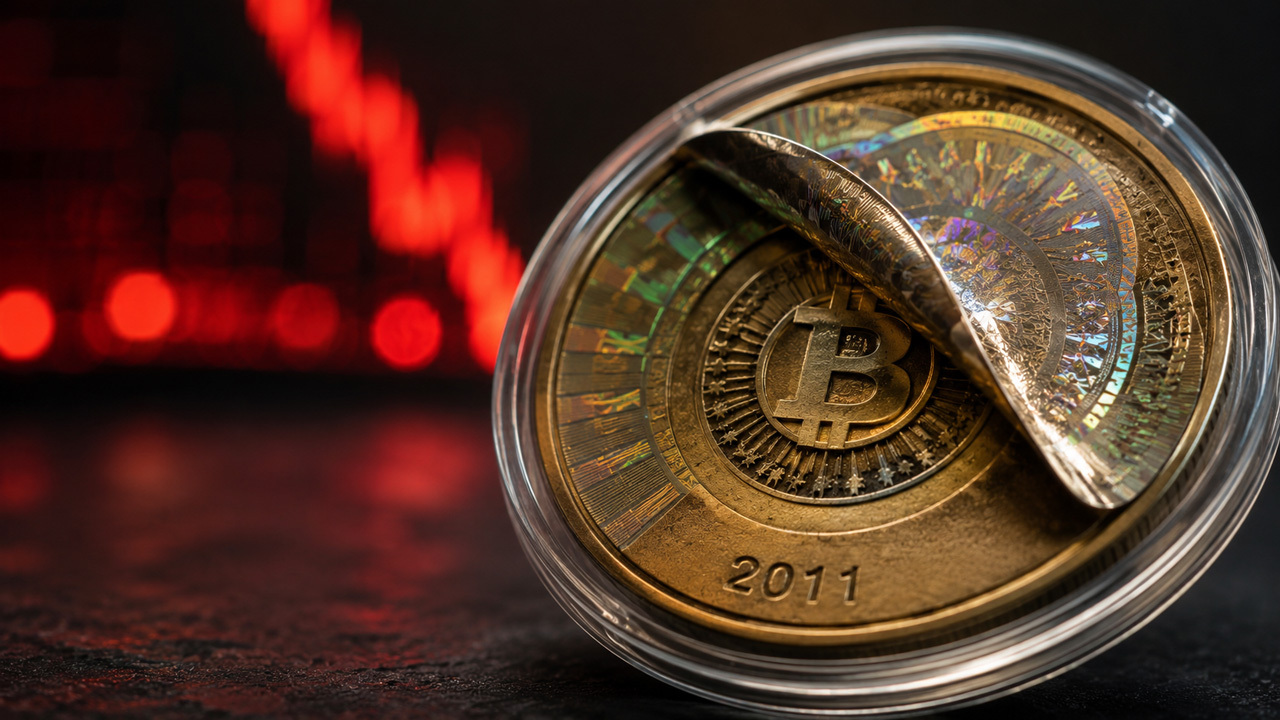
A 2011 physical Bitcoin just woke up. During the $62k selloff, a Casascius coin loaded with 25 BTC moved for the first time in 15 years, turning a collectible into spendable Bitcoin. The event, tracked by Galaxy Research, reignites questions about old-coin selling pressure and offers a unique window into long-term holder behavior.
The Signal: Two Transactions, One Mystery
The move happened in two transactions on June 3 and 4, 2026. The first, in block 952,159, spent 25.00002187 BTC from the original address 1FeexV6bAHb8ybZjqQMjJrcCrHGW9sb6uF, returning 24.98998 BTC to the same address after fees. The second, in block 952,267, moved 24.98996629 BTC to a SegWit address (bc1qn5snfwq447vge9ynnz66xqm9kpam9eu34z52dk), leaving the original address with zero balance. The estimated value of the 25 BTC at the time was roughly $1.78 million, based on a Bitcoin price of $71,200.

The event is significant because it proves a private key associated with a physical object has been used. However, there is no evidence of an exchange deposit or sale. As CryptoSlate notes, it's similar to early Mt. Gox movement alerts: the initial signal is a custody change, not a confirmed sale. The next critical step is to track whether the funds reach an exchange. The original address was attributed to a Casascius coin by Galaxy Research, based on historical transaction patterns and the exact 25 BTC amount, which matches typical denominations of those coins.
“A 2011 physical Bitcoin moved for the first time in 15 years, but there's still no evidence of a sale. Patience is key.”
On-Chain Data: Technical Breakdown

- Original Address: 1FeexV6bAHb8ybZjqQMjJrcCrHGW9sb6uF (attributed to Casascius by Galaxy Research).
- First Transaction (June 3): Block 952,159, spent 25.00002187 BTC, returned 24.98998 BTC to same address. Fee: 0.01004187 BTC (~$715).
- Second Transaction (June 4): Block 952,267, moved 24.98996629 BTC to bc1qn5snfwq447vge9ynnz66xqm9kpam9eu34z52dk (SegWit). Fee: 0.00001402 BTC (~$1).
- Total Fee: 1,371 sats (0.00001371 BTC), extremely low for a transaction of this size, suggesting the sender was not in a hurry.
- Final Balance of Original Address: 0 BTC.

The use of a SegWit address is notable. SegWit addresses (starting with bc1) are more efficient in terms of transaction size and fees, and are common among more experienced users. This could indicate that the new custodian has some technical knowledge. Additionally, the initial transaction with change back to the same address suggests the sender wanted to consolidate UTXOs or simply test the private key before fully moving the funds.
Market Impact: Distribution Signal or False Alarm?
Old-coin movements during a price drop are often interpreted as distribution signals. However, in this case, the data only shows a custody change, not a sale. If the 25 BTC end up on an exchange, they could add selling pressure to an already weakened market. But if they move to another cold wallet, the impact would be minimal. The historical context matters: Casascius coins are numismatic rarities. Their activation could be due to various reasons: the original owner sold the physical coin, lost it and someone found it, or simply decided to spend their bitcoin. The lack of clarity creates uncertainty, but not panic.
It's important to consider current trading volume. With daily Bitcoin exchange volume around $15 billion, a $1.78 million sale would be easily absorbed. However, the psychological effect of seeing old coins move can be disproportionate. Traders often react instinctively to such news, selling out of fear of a distribution wave. But historical data shows that most old-coin movements do not result in immediate sales; many are simply relocations to more secure wallets.
Your Alpha: Practical Strategies to Navigate Uncertainty

For traders and investors, this event offers practical lessons:
- 1Don't assume an immediate sale. Old-coin movements are early signals, not confirmations. Wait to see if funds hit an exchange before adjusting positions. Monitor the receiving address bc1qn5... for at least a week.
- 2Monitor the receiving address. The SegWit address bc1qn5... is now the new custodian. If it sends to a known exchange (Binance, Coinbase, Kraken), the probability of a sale increases significantly. Use tools like Whale Alert or Blockstream Explorer to set up alerts.
- 3Use alert tools. Services like Whale Alert or Blockstream Explorer can notify you of historical address movements. This gives you time to react before the market adjusts. Additionally, consider following on-chain analysts on Twitter for additional context.
Historical Context: The Legacy of Casascius Coins
Casascius coins were created by Mike Caldwell between 2011 and 2013. Each coin contained a private key printed under a hologram, which could be scratched off to reveal the key and spend the bitcoins. An estimated 28,000 coins were minted, with denominations ranging from 0.1 BTC to 1,000 BTC. Many of them were never redeemed and remain as collectibles. The activation of a 25 BTC coin is relatively rare; most coins that move are of smaller denominations.
This event also highlights the evolution of Bitcoin custody. In 2011, physical wallets were a common way to store bitcoins, especially for those who did not trust digital wallets. Today, most holders use hardware wallets or institutional custodians. The movement of a Casascius coin is a reminder that bitcoins still exist in unusual forms, and their activation can happen at any time, often without warning.
Next Catalyst: What to Watch

The market will be watching for any further movement from the receiving SegWit address. If the 25 BTC head to Binance, Coinbase, or Kraken, that would be a bearish signal. Conversely, if they remain idle, the event will become a historical curiosity. Additionally, other old-coin movements could emerge during this correction. Long-term holders often use volatility to relocate funds. Staying alert to similar patterns is key.
It's also possible that more Casascius coins will be activated in the coming weeks, as Bitcoin's price remains above $60,000. Some collectors may be motivated to sell for liquidity, while others may simply be testing their private keys. In any case, the transparency of the blockchain allows analysts to track these movements in real time.
The Bottom Line
The awakening of a Casascius coin with 25 BTC is a reminder that physical Bitcoin still exists and can move at any time. For now, there is no evidence of a sale, but the market must closely watch the receiving address. Patience and on-chain analysis are the best tools to navigate this uncertainty. Stay alert, but don't panic without solid data. History shows that old-coin movements are rarely the prelude to a mass sell-off; they are often just technical relocations. As always, let the data speak before acting.